Commies!
Say hello to Krystine Kercher, author of multifaceted, thought-provoking Christian fantasy series. Today she joins us to discuss the universal subjects of good and evil as well as gender roles in speculative spiritual fiction.
MJN: One of the readers expressed gratification
over the general "good triumphs over evil" in your novels. But there
are so few clear-cut happy endings in history. And sometimes it takes a while
to see the results of good work. Sometimes good triumphs, but the casualties
are horrendous. What is your personal definition of "good triumphs over
evil"? Obviously, when you write fantasy, it's easier to manipulate the
outcome to fit the desirable idea of "good guys" winning.
KK: On
a day to day basis, good triumphs over evil even when we fall down on the job
or fail spectacularly as long as we keep going to our knees in repentance then
getting back up again and pressing on. Triumphing over evil is a daily battle
that takes persistence and intentionality.
From a wider, eternal perspective: God has already dealt our enemy the fatal blow, but he's still very dangerous and he isn't going down without a fight. You might say we're in the "mopping up" phase of an ongoing war... If we get sloppy, we can still lose battles and there will be some casualties along the way, but with God on our side, we've got the high ground and the end is in sight. Now we fight hard to the finish!
From a wider, eternal perspective: God has already dealt our enemy the fatal blow, but he's still very dangerous and he isn't going down without a fight. You might say we're in the "mopping up" phase of an ongoing war... If we get sloppy, we can still lose battles and there will be some casualties along the way, but with God on our side, we've got the high ground and the end is in sight. Now we fight hard to the finish!
MJN: Most fantasies are set in some sort of loosely defined historical period and ethnic mythology. Your idol, J.R.R. Tolkien, relieved heavily on Norse esthetics to create his realms. In the Exile series, we tap into Middle Eastern motifs.
KK: There
is a lot of archaeological evidence for active trade routes between Scandinavia
and the Middle East. When I started researching, I became fascinated with the
idea of how these two very different cultures would interact, plus I'm really
interested in everything Byzantine. The Byzantine Empire was a major player in
European and Middle Eastern politics for 1100 years, and yet today most people
are hardly aware that it existed!
Those 1100 years were crucial to the formation of western civilization, having a huge impact on our calendar, determining which books would be included in the Bible (and in what order), and setting the stage for the western world's interactions with the Middle East even today. Byzantines made significant contributions to the fields of architecture and science as well as the art of war.
Those 1100 years were crucial to the formation of western civilization, having a huge impact on our calendar, determining which books would be included in the Bible (and in what order), and setting the stage for the western world's interactions with the Middle East even today. Byzantines made significant contributions to the fields of architecture and science as well as the art of war.
There are historical and mechanical artifacts from
that time period that are really fascinating too! I'm looking forward to
including some of these nifty inventions in my stories where appropriate.
MJN: How do you tread the fine line between writing Christian-themed fantasy without sounding too moralistic? That's what many Christian authors struggle with.
KK: I
practice that golden rule of writing wherever possible: show, don't tell.
I give my characters freedom to explore their faith
and lack of it, their virtues and their flaws. Of course, actions have
reactions and consequences, and they can be downright painful, but writing
those scenes well is what makes characters come across as more human, more
real. That, I believe, illustrates the beauty of the Gospel: Christ didn't come
to save us because we're perfect; He came because we're flawed and broken, and
desperately hurting. God's grace and mercy, and His divine intervention provide
a sweet, healing counterpoint to the jangling misery caused by our brokenness
and failure.
The more honesty I can infuse into my characters,
the less moralistic they come across. Also--not everyone in my books chooses to
follow God. Some do; some don't; some follow more poorly than others. They're
people like us, trying to figure life out. God doesn't always bail them out of
their messes, either.
It is very important to me not to sugar coat my
stories.

MJN: Tell me about the gender roles in your books. Mythology is filled with goddess-like heroines, while documented history has not always been kind of fair to women. Do your heroines adhere to the "woman of valor" ideal in the Judeo-Christian scriptures, or do they have more in common with their pagan counterparts of the pre-Christian myths?
KK: When
you mention "women of valor, the biblical account of Jael driving the tent
peg into Sisera's head comes to mind, as does the account of Deborah leading
the people of Israel to war, Queen Esther, and Judith from the Apocrypha. There
are definitely women of valor in that tradition represented in my books,
although there are plenty who embrace a more traditional role too.
There are also people worshiped as gods and
goddesses, but while they were created immortal and perfect, they now have a
broken, damaged side and vulnerabilities too.
Probably the biggest group that collectively breaks
the traditional gender roles mold is the mermaids (see A Shadowon the Land and King's Ride), who are ruled by a queen. Because of
the nature of their realm and the requirements it places on them for survival,
mermaids take on most of the leadership roles in their society and do most of
the work outside their cities while their men stay closer to home.
In Astarkand traditional women's roles come with a
twist: Kandian women may look decorative at court and be expected to marry to
cement political alliances, but at home they run their estates and keep track
of the finances, and are capable of organizing a refugee encampment or a royal
feast at a moment's notice (Eiathan's Heir). Maeve, the Duchess of Firewind,
even rides with Bjorn to rescue her stepson and her city from an evil plot.
Then, there's the seeress, Kera, whose role as a
prophetess means that the Horsethain treats her with great respect. Although
she's just a slip of a girl in Galthain's Bones, I think we could consider her a
woman of valor.
On the Horse Plains, women among the Traders train
with swords for self defense because life on the road can turn dangerous with
little to no warning. Although she is expected to fill a more traditional
role, Bjorn's sister Melora sneaks away from home to train with the Trader
women. Plains women are also famous for being accomplished horsewomen.
In contrast to the more liberal and flexible
society on the Horse Plains, women of Dracaena are seldom seen outside a harem
unless they are slaves or without a male protector, and they avoid talking to
men who aren't members of their family or their immediate household. In spite
of this (or because of it?), married men in Dracaenan society have a tendency
to be rather henpecked.
Men's roles generally tend to be more
straightforward but there are some notable exceptions:
Bjorn's training for knighthood also includes
learning how to mend his own clothes and how to cook and clean, and other chores
traditionally seen as "women's work." Bjorn's mentor, Sir Kyle, is
his father's trusted right hand man, but one of his most important jobs is
training and mentoring Bjorn, which means he comes in for a lot of babysitting
Bjorn and his cousins and friends.
Men and women in Horse Plains society share the
effort of raising children. Bjorn's father is highly regarded because he's
a good Horsethain, a great war leader, and he's a large, powerfully built man,
but the feat he's best known and appreciated for is raising his sons well. With
seven sons this is no easy task!
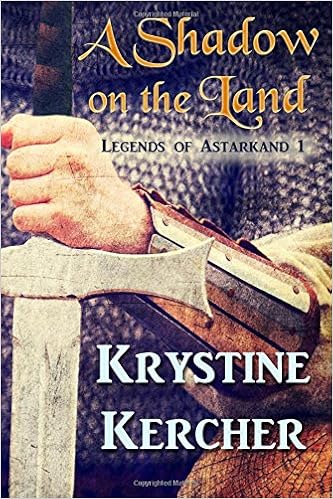
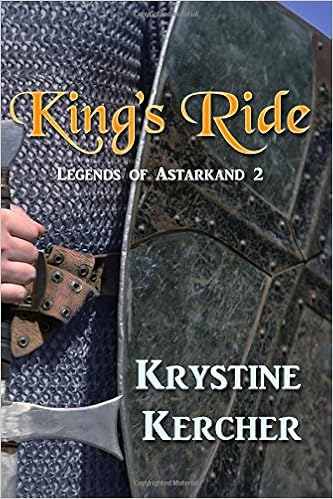
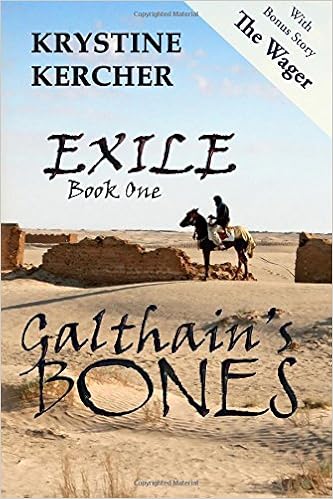
MJN: The covers of Astarkand feature an armored knight. On the first two books you just had the armor and his hand. On the third cover you actually see more of his figure, though his eyes are still covered. It's like he is gradually revealing himself more and more to the reader. Was that intentional?
KK: This
progression was more serendipitous than intentional. I could make it intentional now...but...I need the right model to continue the
theme! Any offers? (hint hint)
I could really use a model with blond curly hair
like Bjorn's and real chain mail, etc. to add that realistic edge to bring the
photography to the next level from pretend to "real to life". I could
also use stock photos of a few appropriately dressed women in medieval costume
who are not in embarrassingly awful poses... I can't pay much, but for the
right photos, I would be willing to pay something--if the photographer and I
can come to an agreement on what's reasonable.