Greetings, commies!
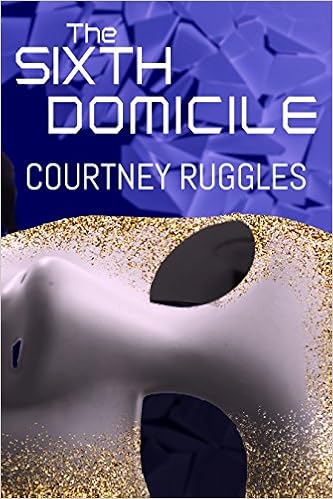
Joining the network of Dystopian authors has opened a door to some stimulating literary connections. Say hello to Courtney Ruggles, the author of The Domicile series. The Sixth Domicile, the first book in the series, is a tale of rebellion against a tyrannical regime.
Synopsis:
In a future ravaged by greed and war, The Domicile has emerged. A new
civilization governed by clandestine Elders where citizens are united by
white masks and uniform identities. To remove one’s mask, to go outside
the Domicile, to show defiance, means being sent to the Meurtre, a
horrifying death sentence.
My thoughts:
Any time there is an alternate Dystopian universe, the author is faced with the challenge of feeding the background information to the author without making any of the characters sound like token commentators aka "talking heads". Courtney Ruggles does a fine job creating a believable Dystopian universe while covering up the seams. As with any tyrannic totalitarian regime, there are those who support it ardently, those who tolerate it begrudgingly, and those who rebel against it.
Based from the premise of all individuals being forced to wear uniform masks, regardless of the individual features underneath, I can tell that the author must have watched Pink Floyd's "The Wall" and "Eyes Wide Shut". There is something infinitely horrifying about a static form covering human features. And yet, the characters, whose names are reduced to a combination of letters and numbers, still manage to fall in love. Developing feelings for someone without seeing his/her face is similar two two blind people falling in love. At the same time, when people are forced to wear uniforms or masks, they have to work harder to make their essence shine through. There is certain energy that artificially imposed veneers cannot contain.
Sunday, May 29, 2016
Saturday, May 21, 2016
The Wheel's Final Turn - Monica Brinkman's metaphysical gem
Commies,
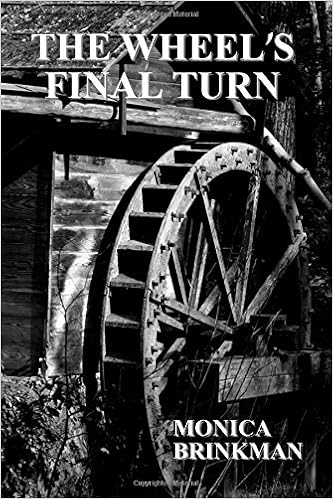
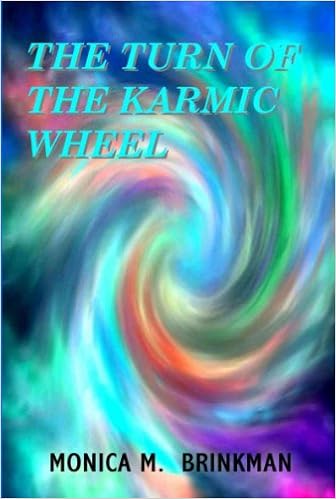
I have been dying to post the review for The Wheel's Final Turn, the sequel to Monica Brinkman's metaphysical novel The Turn of the Karmic Wheel.
Synopsis:
In The Wheel's Final Turn, the sequel to The Turn of The Karmic Wheel, Angela, Euclid, and Karman once again find themselves thrust front and center into the battle between good and evil. One man finds pleasure in torturing animals; another fights the demons of past hate crimes. From the governor's mansion to the highly competitive beauty industry to the hidden closets of memory, no one is safe from the grasp of the darkness that wants to take over the world. Can the forces of Light find the inner strength to save humanity, or will the world fall eternal victim to evil as the karmic wheel makes its final turn?
My thoughts:
I would like to comment on the author's literary style. Subtle horror, in the tradition of Southern Gothic. Brinkman's eloquent, polyphonic narrative echoes of Faulkner. The diction is both gritty and sublime. I imagine, the author has read her fair share of Latin American novels in the magical realism genre. That would explain her appreciation for sensuous micro-detail. I also see the melancholic traces of Philip Roth. If I understand the author's outlook on life correctly, evil is not always overt and in-your-face. Nor does it take over your soul overnight. It's a gradual, clandestine process, like cancer. Any one of us can become a channel of evil. Sometimes something as seemingly minor as a childhood slight or a conflict with a parent can open up a wound that will fester. There are several story lines in her novel, all being intertwined by the same sinister puppet master.
I have been dying to post the review for The Wheel's Final Turn, the sequel to Monica Brinkman's metaphysical novel The Turn of the Karmic Wheel.
Synopsis:
In The Wheel's Final Turn, the sequel to The Turn of The Karmic Wheel, Angela, Euclid, and Karman once again find themselves thrust front and center into the battle between good and evil. One man finds pleasure in torturing animals; another fights the demons of past hate crimes. From the governor's mansion to the highly competitive beauty industry to the hidden closets of memory, no one is safe from the grasp of the darkness that wants to take over the world. Can the forces of Light find the inner strength to save humanity, or will the world fall eternal victim to evil as the karmic wheel makes its final turn?
My thoughts:
I would like to comment on the author's literary style. Subtle horror, in the tradition of Southern Gothic. Brinkman's eloquent, polyphonic narrative echoes of Faulkner. The diction is both gritty and sublime. I imagine, the author has read her fair share of Latin American novels in the magical realism genre. That would explain her appreciation for sensuous micro-detail. I also see the melancholic traces of Philip Roth. If I understand the author's outlook on life correctly, evil is not always overt and in-your-face. Nor does it take over your soul overnight. It's a gradual, clandestine process, like cancer. Any one of us can become a channel of evil. Sometimes something as seemingly minor as a childhood slight or a conflict with a parent can open up a wound that will fester. There are several story lines in her novel, all being intertwined by the same sinister puppet master.
Tuesday, May 17, 2016
Carrie Welton - a novel of New England tomboy
Salutations to all of you, Connecticut Commies!
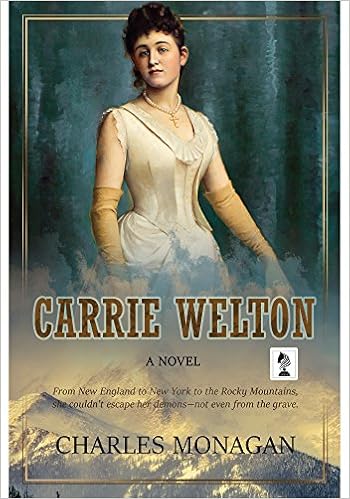
In a mood for some nutmeg? Today's guest of honor is a fellow Connecticut Commie and Penmore Press author Charles Monagan. His novel Carrie Welton is set in Waterbury, CT.
Synopsis:
Eighteen-year-old Carrie Welton is restless, unhappy, and ill-suited to the conventions of nineteenth-century New England. Using her charm and a cunning scheme, she escapes the shadow of a cruel father and wanders into a thrilling series of high-wire adventures. Her travels take her all over the country, putting her in the path of Bohemian painters, poets, singers, social crusaders, opium eaters, violent gang members, and a group of female mountain climbers.
But Carrie’s demons return to haunt her, bringing her to the edge of sanity and leading to a fateful expedition onto Longs Peak in Colorado. That’s not the end, though. Carrie, being Carrie, sends an astonishing letter back from the grave and thus engineers her final escape—forever into your heart.
My thoughts:
What sets Carrie Welton apart is the rarely used first person omniscient narrative. Rarely do you see a novel in which the title character not being the speaker. The same narrative model was used in Jack London's The Sea-Wolf and Nabokov's Lolita. The heroine of Charles Monagan's novel, Caroline Welton, becomes the object of fascination to Frederick Kingsbury, a dutiful family man with an equally dutiful and sympathetic wife. The Kingsburys become personally invested in the emotional and social well-being of the troubled girl next door, championing her independence and artistic growth.
Tolstoy claims that "Happy families are all alike; every unhappy family is unhappy in its own way." While there are many variables that contribute to each family's dysfunction, and there are many creative ways people can sabotage their home lives, but, leaning on my personal experience, dysfunctional families have certain "key ingredients" in common. I've seen enough dysfunctional New England families. I've seen enough tyrannical fathers who make occasional cameo appearances just to stomp their feet a few times and bark. I've seen enough oblivious wives who seek validation by throwing lavish parties. And I've seen enough lonely children who bond with animals and neighbors than they do with their own parents.
Monagan paints a vivid picture of social anxiety and PTSD before those conditions were explored and labeled. His speaker, Kingsbury, maintains an outlook that is consistent with his era. There are references to the key Civil War battles, the draft riots in New York City, the Bohemian art scene. It's such a daunting task to keep the 21st century author and the 19the century speaker separate. There are so many opportunities for slip-ups and inadvertent anachronisms, and Monagan manages to avoid them all. The most impressive feat, however, is the exquisite, unobtrusive transition from first person limited to first person omniscient. At some point the reader realizes that Kingsbury describes events that did not happen before his very eyes. In the first half of the novel, he is in close physical proximity to his protegee. He pays painstaking attention to her body language, her smile, her features. After Carrie moves away, he continues to chronicle her adventures from afar, imagining what her daily life might have been. He feels her from a distance. At the same time, Kingsbury's fascination is refreshingly chaste. He does not devolve into a dirty old man who becomes obsessed with the vulnerable girl next door. I admit to having feared that the story line would head in the Lolita direction, but thankfully, it did not.
Apart from being a top-notch authentic historical novel, Carrie Welton is a commendable exercise in unorthodox narrative.
In a mood for some nutmeg? Today's guest of honor is a fellow Connecticut Commie and Penmore Press author Charles Monagan. His novel Carrie Welton is set in Waterbury, CT.
Synopsis:
Eighteen-year-old Carrie Welton is restless, unhappy, and ill-suited to the conventions of nineteenth-century New England. Using her charm and a cunning scheme, she escapes the shadow of a cruel father and wanders into a thrilling series of high-wire adventures. Her travels take her all over the country, putting her in the path of Bohemian painters, poets, singers, social crusaders, opium eaters, violent gang members, and a group of female mountain climbers.
But Carrie’s demons return to haunt her, bringing her to the edge of sanity and leading to a fateful expedition onto Longs Peak in Colorado. That’s not the end, though. Carrie, being Carrie, sends an astonishing letter back from the grave and thus engineers her final escape—forever into your heart.
My thoughts:
What sets Carrie Welton apart is the rarely used first person omniscient narrative. Rarely do you see a novel in which the title character not being the speaker. The same narrative model was used in Jack London's The Sea-Wolf and Nabokov's Lolita. The heroine of Charles Monagan's novel, Caroline Welton, becomes the object of fascination to Frederick Kingsbury, a dutiful family man with an equally dutiful and sympathetic wife. The Kingsburys become personally invested in the emotional and social well-being of the troubled girl next door, championing her independence and artistic growth.
Tolstoy claims that "Happy families are all alike; every unhappy family is unhappy in its own way." While there are many variables that contribute to each family's dysfunction, and there are many creative ways people can sabotage their home lives, but, leaning on my personal experience, dysfunctional families have certain "key ingredients" in common. I've seen enough dysfunctional New England families. I've seen enough tyrannical fathers who make occasional cameo appearances just to stomp their feet a few times and bark. I've seen enough oblivious wives who seek validation by throwing lavish parties. And I've seen enough lonely children who bond with animals and neighbors than they do with their own parents.
Monagan paints a vivid picture of social anxiety and PTSD before those conditions were explored and labeled. His speaker, Kingsbury, maintains an outlook that is consistent with his era. There are references to the key Civil War battles, the draft riots in New York City, the Bohemian art scene. It's such a daunting task to keep the 21st century author and the 19the century speaker separate. There are so many opportunities for slip-ups and inadvertent anachronisms, and Monagan manages to avoid them all. The most impressive feat, however, is the exquisite, unobtrusive transition from first person limited to first person omniscient. At some point the reader realizes that Kingsbury describes events that did not happen before his very eyes. In the first half of the novel, he is in close physical proximity to his protegee. He pays painstaking attention to her body language, her smile, her features. After Carrie moves away, he continues to chronicle her adventures from afar, imagining what her daily life might have been. He feels her from a distance. At the same time, Kingsbury's fascination is refreshingly chaste. He does not devolve into a dirty old man who becomes obsessed with the vulnerable girl next door. I admit to having feared that the story line would head in the Lolita direction, but thankfully, it did not.
Apart from being a top-notch authentic historical novel, Carrie Welton is a commendable exercise in unorthodox narrative.
Monday, May 16, 2016
We the Peeps - a political satire by Morgan Hunt
Greetings, commies!
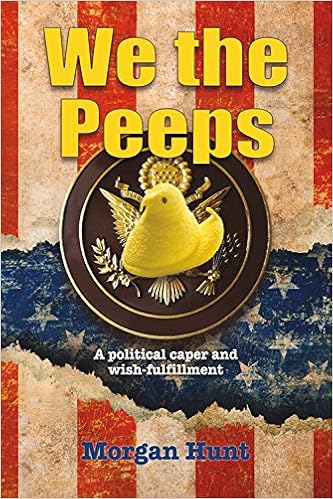
In light of the recent political upheavals, I am delighted to review a novel by Morgan Hunt We the Peeps: a Political Caper and Wish Fulfillment.
Synopsis:
When seven ordinary citizens are unreasonably detained by the TSA, they bond over their upset with the government and decide to launch a second American Revolution. Instead of horses and artillery, they rely on media distractions, scams, and hacking. They take on green energy, deregulation, Citizens United and other issues with whimsical yet hopeful results. We the Peeps is a fun read for all who are interested in politics, civics, democracy and the American experience.
My thoughts:
Writing an effective political satire takes the right balance of factual awareness, sense of humor, contempt for humanity and healthy detachment. If the author is too passionate about a particular political movement, the work of fiction turns into a manifesto or a piece of propaganda. Fortunately, Morgan Hunt, the author of We the Peeps dodges that bullet. Intuition tells me that in her daily life she is leaning towards the left (don't ask me how I know it), she has no qualms about ridiculing the extremism of the phenomenon known as Social Justice Warriors.
If you you take wicked pleasure in trivializing and lampooning "human suffering" (aka First World Problems), this is the book for you! The novel features an ensemble cast of misfits from various walks of life, brought together by fate and united in a cause. Lovers of Sartre will instantly think of the set up of No Exit, where you have incompatible individuals trapped within one hell circle.
Like any good satirist, Hunt employs word play. The president's name is Peabody. (Peabrain is more like it!) A sensitive, ineffectual, sentimental, ethnically confused, borderline metrosexual, p-whipped (there comes the letter P again), by his philanthropic ex-fiancee Demetra, who rejects traditional family in favor of providing medical care to third world orphans.
The author resurrects many common questions that are on everyone's mind but cannot be raised in politically correct society. Does having an Algonquin great-grandmother allow you to claim Native American roots? Does a privileged Indian career woman have a right to speak on behalf of "women of color"? Can a man continue to serve as a Methodist minister even if he comes out of the closet? People massage their heritage and history to their advantage. The cover features a cute yellow baby chick, implying that in the world of social media, even puny, squeaky voices can make a lot of impact.
My only concern is that this clever book has a shelf life - like all political satires. The novel takes place in a near future, 20XX. The author makes references to political figures that are still alive and in power, like Putin. Some thinly-veiled political runners make cameo appearances, like a certain billionaire named Hrump (gee, I wonder who that is ...) Ten years from now these people could be ancient history. But that's the risk that all writers of political satire take. Their work is biting and catchy and relevant while the figures are alive and in the spotlight. The "good" news is that the problems outlined in the book are not likely to go away any time soon. Terrorism, school shootings, energy crisis are here to stay. Regardless of where you stand on the political scale, you will find We the Peeps poignant and witty.
In light of the recent political upheavals, I am delighted to review a novel by Morgan Hunt We the Peeps: a Political Caper and Wish Fulfillment.
Synopsis:
When seven ordinary citizens are unreasonably detained by the TSA, they bond over their upset with the government and decide to launch a second American Revolution. Instead of horses and artillery, they rely on media distractions, scams, and hacking. They take on green energy, deregulation, Citizens United and other issues with whimsical yet hopeful results. We the Peeps is a fun read for all who are interested in politics, civics, democracy and the American experience.
My thoughts:
Writing an effective political satire takes the right balance of factual awareness, sense of humor, contempt for humanity and healthy detachment. If the author is too passionate about a particular political movement, the work of fiction turns into a manifesto or a piece of propaganda. Fortunately, Morgan Hunt, the author of We the Peeps dodges that bullet. Intuition tells me that in her daily life she is leaning towards the left (don't ask me how I know it), she has no qualms about ridiculing the extremism of the phenomenon known as Social Justice Warriors.
If you you take wicked pleasure in trivializing and lampooning "human suffering" (aka First World Problems), this is the book for you! The novel features an ensemble cast of misfits from various walks of life, brought together by fate and united in a cause. Lovers of Sartre will instantly think of the set up of No Exit, where you have incompatible individuals trapped within one hell circle.
Like any good satirist, Hunt employs word play. The president's name is Peabody. (Peabrain is more like it!) A sensitive, ineffectual, sentimental, ethnically confused, borderline metrosexual, p-whipped (there comes the letter P again), by his philanthropic ex-fiancee Demetra, who rejects traditional family in favor of providing medical care to third world orphans.
The author resurrects many common questions that are on everyone's mind but cannot be raised in politically correct society. Does having an Algonquin great-grandmother allow you to claim Native American roots? Does a privileged Indian career woman have a right to speak on behalf of "women of color"? Can a man continue to serve as a Methodist minister even if he comes out of the closet? People massage their heritage and history to their advantage. The cover features a cute yellow baby chick, implying that in the world of social media, even puny, squeaky voices can make a lot of impact.
My only concern is that this clever book has a shelf life - like all political satires. The novel takes place in a near future, 20XX. The author makes references to political figures that are still alive and in power, like Putin. Some thinly-veiled political runners make cameo appearances, like a certain billionaire named Hrump (gee, I wonder who that is ...) Ten years from now these people could be ancient history. But that's the risk that all writers of political satire take. Their work is biting and catchy and relevant while the figures are alive and in the spotlight. The "good" news is that the problems outlined in the book are not likely to go away any time soon. Terrorism, school shootings, energy crisis are here to stay. Regardless of where you stand on the political scale, you will find We the Peeps poignant and witty.
Monday, May 9, 2016
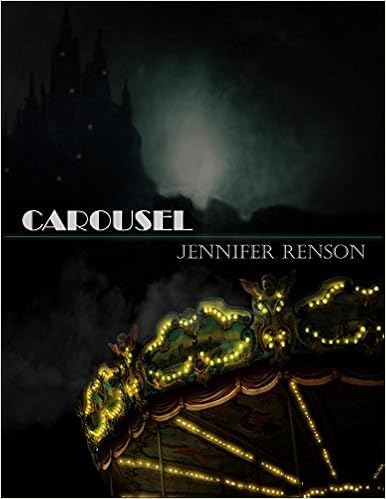
Carousel - a comedia dell'arte fantasy - by Jennifer Renson
Morning, commies!
I am thrilled to host an award-winning YA fantasy author, Jennifer Renson. I read her fantasy novel Carousel in one gulp.
Synopsis:
After living in the countryside for years, Princio returns to his homeland, the tiny yet prosperous Kingdom of Lucca, upon the orders of his dying grandfather. Living alone in the annexed building next to the palace, Princio is discovered by the kingdom’s chief doll maker, Feletti, who purposely withholds his knowledge of Princio’s past in order to gain his trust and friendship. Princio believes Feletti to be a true friend until he meets Marian, a girl with a penchant for cooking and a natural curiosity, and their chance meeting in the kingdom’s carousel sets off a series of events with the potential to change everything. As Princio, Marian, and Feletti’s dark secrets begin to unfurl, their lives slowly come to light – as love hangs delicately in the balance...
My thoughts
Every fantasy realm has its roots in a particular ethnic tradition. Lord of the Rings is rooted in Norse mythology. Jennifer Renson draws her inspiration from the comedia dell'arte aesthetics. I have not seen many fantasy tales set in southern Europe, so I am delighted to a fantasy novella set in pseudo-Romanesque universe. You have Feletti, an enigmatic, pseudo-demonic doll maker/puppet master, and Marian, his creation. If you are a fan of The Nutcracker, you probably will compare Feletti to Drosselmeyer. The whole concept of a doll coming to life is archetypal and universal. (For a brief moment, I had a flashback to Ridley Scott's Bladerunner.) There is a touch of the Pygmalion myth, the creator falling in love with his own creation.
Masks are a running motif. Interestingly, it is a romantic hero who believes himself to be ugly and therefore hides his faced underneath the mask. In the western tradition, it is the female who suffers from the body dysmorphic disorder. Although, there are several timeless tales of a deformed male with a noble soul. I guess, the western world can accept a deformed hero - or one who perceives himself to be deformed - but for a woman, being anything less than doll-like is unacceptable. Hence, the prevalence of BDD among western women.
There are references to various Christian holidays and Catholic practices. So while this is not a "Christian" or "inspirational" fantasy, it is a fantasy set in the context of Catholicism. The Pope and the Catholic church provide an esthetic backdrop. The tone is not evangelical in the least.
Overall, I adore how boldly the author flirts with the traditional fairy-tale archetypes, turning them topsy-turvy and rearranging them. The author's clean, innocent, forward "once upon a time" narrative makes the novella accessible for younger readers yet sophisticated enough for older readers. I would be delighted to see it as a graphic novel. I can only imagine what a gifted illustrator could do with all the rich imagery.
I am thrilled to host an award-winning YA fantasy author, Jennifer Renson. I read her fantasy novel Carousel in one gulp.
Synopsis:
After living in the countryside for years, Princio returns to his homeland, the tiny yet prosperous Kingdom of Lucca, upon the orders of his dying grandfather. Living alone in the annexed building next to the palace, Princio is discovered by the kingdom’s chief doll maker, Feletti, who purposely withholds his knowledge of Princio’s past in order to gain his trust and friendship. Princio believes Feletti to be a true friend until he meets Marian, a girl with a penchant for cooking and a natural curiosity, and their chance meeting in the kingdom’s carousel sets off a series of events with the potential to change everything. As Princio, Marian, and Feletti’s dark secrets begin to unfurl, their lives slowly come to light – as love hangs delicately in the balance...
My thoughts
Every fantasy realm has its roots in a particular ethnic tradition. Lord of the Rings is rooted in Norse mythology. Jennifer Renson draws her inspiration from the comedia dell'arte aesthetics. I have not seen many fantasy tales set in southern Europe, so I am delighted to a fantasy novella set in pseudo-Romanesque universe. You have Feletti, an enigmatic, pseudo-demonic doll maker/puppet master, and Marian, his creation. If you are a fan of The Nutcracker, you probably will compare Feletti to Drosselmeyer. The whole concept of a doll coming to life is archetypal and universal. (For a brief moment, I had a flashback to Ridley Scott's Bladerunner.) There is a touch of the Pygmalion myth, the creator falling in love with his own creation.
Masks are a running motif. Interestingly, it is a romantic hero who believes himself to be ugly and therefore hides his faced underneath the mask. In the western tradition, it is the female who suffers from the body dysmorphic disorder. Although, there are several timeless tales of a deformed male with a noble soul. I guess, the western world can accept a deformed hero - or one who perceives himself to be deformed - but for a woman, being anything less than doll-like is unacceptable. Hence, the prevalence of BDD among western women.
There are references to various Christian holidays and Catholic practices. So while this is not a "Christian" or "inspirational" fantasy, it is a fantasy set in the context of Catholicism. The Pope and the Catholic church provide an esthetic backdrop. The tone is not evangelical in the least.
Overall, I adore how boldly the author flirts with the traditional fairy-tale archetypes, turning them topsy-turvy and rearranging them. The author's clean, innocent, forward "once upon a time" narrative makes the novella accessible for younger readers yet sophisticated enough for older readers. I would be delighted to see it as a graphic novel. I can only imagine what a gifted illustrator could do with all the rich imagery.
Friday, May 6, 2016
Into the Darkness of Daylight - an intelligent sci-fi gem by Lisa Gytri
Hello commies and lovers of sci-fi!
I am pleased to spotlight the author of
the day, Lisa Gytri, a renaissance woman on so many levels: author, engineer,
traveler and athlete. Today I am pleased to review her debut novel Into the Darkness of Daylight.
Synopsis
Jim Wells has always been haunted by
telepathic messages from alien beings. When these beings attempt to come to
Earth to harvest humans and process them into a special form of narcotics made
from human emotions, Jim hijacks a ballistic missile to take them down.
After escaping into a network of caverns, Jim hides quietly away from humanity until he learns of another alien ship's impending arrival. On the Korean Peninsula, Jim will risk sparking a global war to thwart the imperialistic plans of his cosmic enemy.
My
thoughts
There are so many novels on similar
subjects, featuring aliens and caverns, written by far less skilled authors
than Gytri. As a long-time co-editor of a speculative fiction e-zine, I have
read my share of conspiracy flavored sci-fi of marginal quality that suggests
that the author may have read some light fiction in the same genre but does not
necessarily possess profound knowledge of science. Into the Darkness of Daylight showcases Gytri's multi-dimensional erudition. Her experience
shines through in this eloquent, fast-paced masterpiece. An engineer and an
avid traveler in real life, Gytri thinks like a scientist. Her diction is
crisp, clear and poignant, visceral in certain places. Her genderless voice as
a peculiar extraterrestrial quality. Her narrative moves swiftly across the
globe. If you like the themes of 2001: Space Odyssey and Close
Encounters of the Third Kind, you will appreciate Into the Darkness ofDaylight - a well-oiled machine (or space ship, or a missile) on so many
levels.
Tuesday, May 3, 2016
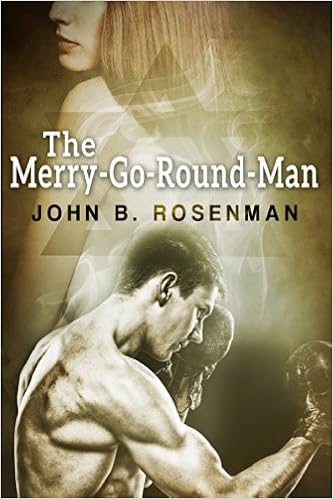
Chocolate candy with a bitter center - The Merry-Go-Round Man by John Rosenman
Greetings, commie!
A few months ago I posted an interview with John Rosenman, known for his sci-fi and fantasy novels. Today I am posting a review of his nostalgic novel The Merry-Go-Round Man.
Synopsis:
Do you believe you can shape your future, determine your destiny? One spring day in 1954, three sixth grade boys make a bet: the one who can climb first to the top of a small green merry-go-round outside their school will be “Champ for life!” For the rest of his days he’ll be “on Easy Street!” So they engage in a “mad scramble . . . clambering over each other with murderous intent,” and eventually one of them reaches the summit and stands triumphant, lording it over the others. He is the merry-go-round man.
The Merry-Go-Round Man is a novel about three boys growing up in the so-called innocent days of the Eisenhower fifties. It’s about rites of passage, loss of innocence, sexual initiation, racism, and much more . Of the three boys, Johnny Roth is central. He possesses two transcendent gifts which are only beginning to emerge as the novel begins. One of them is the ability to box or fight, something he deeply fears. The other ability is artistic and mystical. He is a natural expressionistic painter of vast potential. Unfortunately, Johnny’s father, an Orthodox Jew, hates both of these pursuits, and his opposition tears Johnny apart.
Of the two other boys, Lee Esner grows up to be a gifted football player with what looks like a lucrative pro career ahead of him. He also has a flair for attracting beautiful girls. Is he the merry-go-round man? The third boy, Jimmy Wiggins, is black and from the ghetto. Attending an elite white school with Johnny and Lee, his naive love for a pretty white girl is destroyed by her cruel racism. Another rite of passage. Symbols such as a burning Buddhist monk make us ask whether anyone is really The Merry-Go-Man in life.
My thoughts:
A merry-go-round is perceived as a symbol of innocence, of cloudless childhood, but in John Rosenman's novel The Merry-Go-Round Man, opening in 1950s Ohio, it becomes a symbol of competition, temptation and hidden menace. In 1950's America was on the cusp of two major movements: the civil rights movement and the sexual revolution. The three main characters - Jimmy, Johnny and Lee - all from different social circles, are products of their era. They are no strangers to the prejudices and misconceptions. They share enough universal boyish interests to stay friends, yet they had already had enough brushes with the outside world to start building invisible fortifications around themselves. I noticed that many reviewers pointed out Johnny as the most interesting character in the book, but I was particularly moved by the delicate and complicated plight of Jimmy, a black boy whose mother goes out of her way to send him to a white school. She wants to see her son succeed in the mainstream society, against all odds, but that does not prevent her from referring to him as "little nigger". I think it would be hypocritical of us to pretend that we are a "color-blind" society. We are not. And we certainly were not in 1950s. African American children who are hurled into a predominantly white environment, often find themselves ostracized by both sides. Even at the age of 12, Jimmy Wiggins already realizes his precarious social status. Same is true for Johnny, who is still being referred to as "kike". Now that's a word you don't hear much on the streets these days, but it doesn't mean that the sentiment of anti-semitism does not exist.
The author does a marvelous job of defying cliches, redefining the symbols, using them in new creative ways, and highlighting the difference between innocence and ignorance. These two concepts are often used interchangeably. Despite the seemingly idyllic setting, The Merry-Go-Round Man is not a typical piece of nostalgic Americana. It's like a chocolate candy in a pastel wrapper with a bitter center.
A few months ago I posted an interview with John Rosenman, known for his sci-fi and fantasy novels. Today I am posting a review of his nostalgic novel The Merry-Go-Round Man.
Synopsis:
Do you believe you can shape your future, determine your destiny? One spring day in 1954, three sixth grade boys make a bet: the one who can climb first to the top of a small green merry-go-round outside their school will be “Champ for life!” For the rest of his days he’ll be “on Easy Street!” So they engage in a “mad scramble . . . clambering over each other with murderous intent,” and eventually one of them reaches the summit and stands triumphant, lording it over the others. He is the merry-go-round man.
The Merry-Go-Round Man is a novel about three boys growing up in the so-called innocent days of the Eisenhower fifties. It’s about rites of passage, loss of innocence, sexual initiation, racism, and much more . Of the three boys, Johnny Roth is central. He possesses two transcendent gifts which are only beginning to emerge as the novel begins. One of them is the ability to box or fight, something he deeply fears. The other ability is artistic and mystical. He is a natural expressionistic painter of vast potential. Unfortunately, Johnny’s father, an Orthodox Jew, hates both of these pursuits, and his opposition tears Johnny apart.
Of the two other boys, Lee Esner grows up to be a gifted football player with what looks like a lucrative pro career ahead of him. He also has a flair for attracting beautiful girls. Is he the merry-go-round man? The third boy, Jimmy Wiggins, is black and from the ghetto. Attending an elite white school with Johnny and Lee, his naive love for a pretty white girl is destroyed by her cruel racism. Another rite of passage. Symbols such as a burning Buddhist monk make us ask whether anyone is really The Merry-Go-Man in life.
My thoughts:
A merry-go-round is perceived as a symbol of innocence, of cloudless childhood, but in John Rosenman's novel The Merry-Go-Round Man, opening in 1950s Ohio, it becomes a symbol of competition, temptation and hidden menace. In 1950's America was on the cusp of two major movements: the civil rights movement and the sexual revolution. The three main characters - Jimmy, Johnny and Lee - all from different social circles, are products of their era. They are no strangers to the prejudices and misconceptions. They share enough universal boyish interests to stay friends, yet they had already had enough brushes with the outside world to start building invisible fortifications around themselves. I noticed that many reviewers pointed out Johnny as the most interesting character in the book, but I was particularly moved by the delicate and complicated plight of Jimmy, a black boy whose mother goes out of her way to send him to a white school. She wants to see her son succeed in the mainstream society, against all odds, but that does not prevent her from referring to him as "little nigger". I think it would be hypocritical of us to pretend that we are a "color-blind" society. We are not. And we certainly were not in 1950s. African American children who are hurled into a predominantly white environment, often find themselves ostracized by both sides. Even at the age of 12, Jimmy Wiggins already realizes his precarious social status. Same is true for Johnny, who is still being referred to as "kike". Now that's a word you don't hear much on the streets these days, but it doesn't mean that the sentiment of anti-semitism does not exist.
The author does a marvelous job of defying cliches, redefining the symbols, using them in new creative ways, and highlighting the difference between innocence and ignorance. These two concepts are often used interchangeably. Despite the seemingly idyllic setting, The Merry-Go-Round Man is not a typical piece of nostalgic Americana. It's like a chocolate candy in a pastel wrapper with a bitter center.
Subscribe to:
Posts (Atom)