Thursday, September 17, 2015

Imagine Glamour Maine Coons - interview with Radka Vacikova

Greetings, commies and cat lovers!

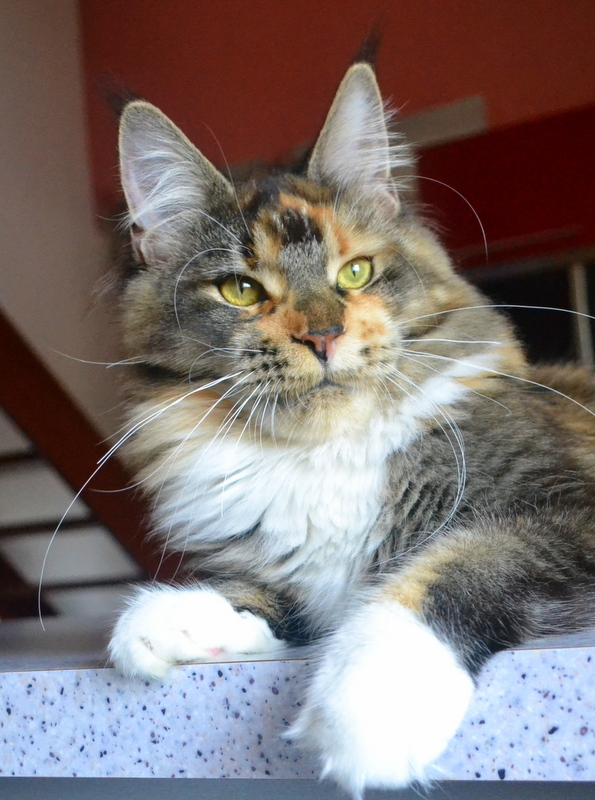
A very special treat for you today – an interview with Radka Vacikova, the proud director of Imagine Glamour Maine Coon Cattery in beautiful Prague. A few months ago I did an interview with a British-born breeder who acquainted Romania with Ragdolls – another American breed. Today Radka talks about best practices in the world of competitive cat breeding.
__________________________________ 

MJN: Maine Coons often get confused with Siberians and Norwegians. How would you explain the different to a person who has nothing to do with felinology? Is it the shape of the head?

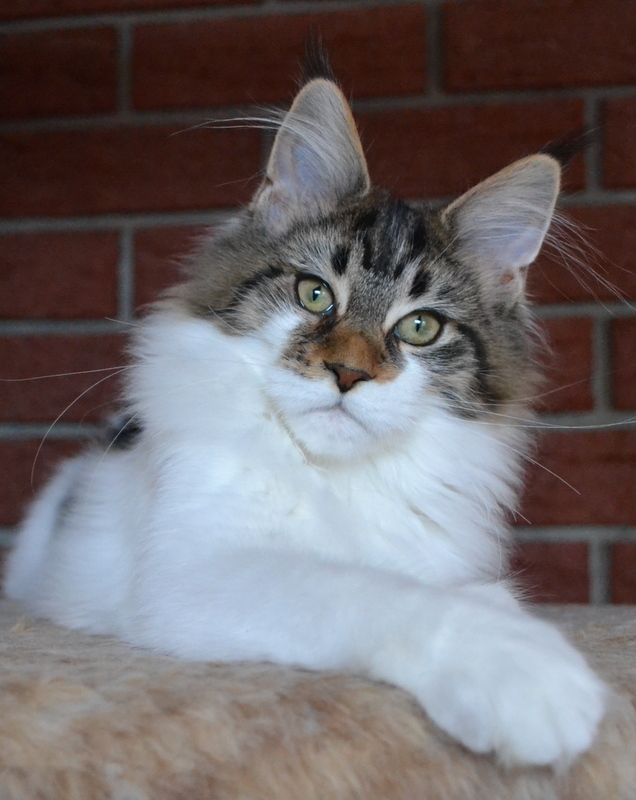
RV: Yes, that´s true that these three breeds can be confused by the lay public. The main difference is the head. Standard of the Maine coons says the head has a square shape, square muzzle, big ears high on the head, strong chin, profile with stop. Norwegians need to have a triangle shape of the head with the high and open ears so that the outer lines follow the line of the head down to the chin and the main difference between Maine Coon and Norwegian is the profile - Norwegians need to have straight profile without break. A difference between Maine Coon and Siberian is especially in the quality of the coat, Siberians have very dense coat with water repellent overcoat slightly hard to touch, Maine Coons have silky coat and in the shape of the head when Siberians have "round" head against Maine Coons.
MJN: In the Czech Republic, do you have the option of buying health insurance for your cats? Is there a higher tier program for cats that are breeding, to cover pregnancy and post-partum period?

RV: Here in the Czech Republic we have some possibility of the insurance, but it means only for some veterinarian service and obviously it is very expensive, especially when you have more of the cats, not only one, two ...

MJN: Among Maine Coons some are polydactyl. Is it an acceptable/desirable trait?

RV: Polydactyls are allowed and supported by some clubs but it is not just my interest and taste. But I know many people who love them :) So why not?

MJN: On your Facebook page, there is a photo of you holding a cat who appears to be huge. In some organizations, the standard is written for the male, because the male is larger. Which means that females do not get sufficiently high scores. Would you say it was true?

RV: I think you mean exactly SC Gale by Imagine Glamour*CZ, JW, DVM, DSM :) He is really huge boy around 11kg. The standard says that there is a difference between males and females of course. So this is absolutely correct despite I know really a big females too. I mean the females around 6-8kg for example. The usual weight of the boys can be between 6-9 kg and the girls between 4-6kg so higher weights means really a huge Maine Coon :)

MJN: Do you ever run into your "graduates" at cat shows? Did you ever find yourself in a situation where your cats would compete against their brothers and sisters at shows?
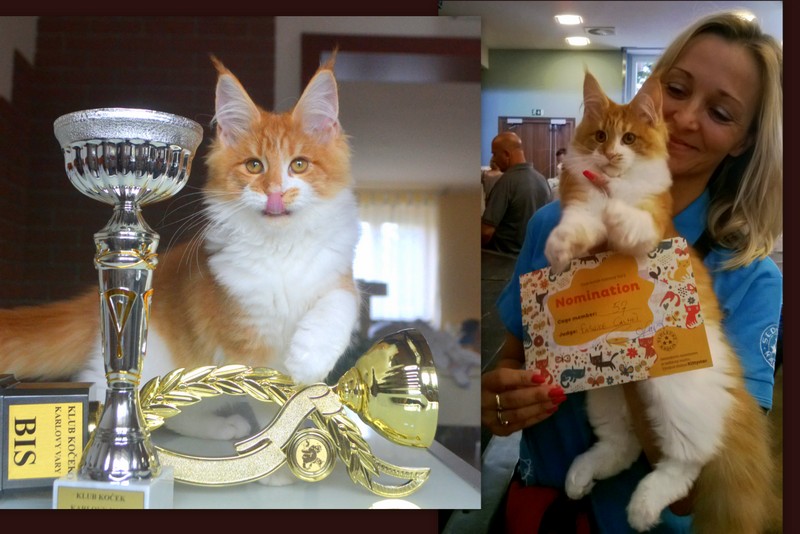
RV: Well, usually I am going only with the young cats, kittens. Only very rarely I can take older cat ("graduates") - it is mean that he/she needs some title or certificates which is not allow to be award to young cats - for example DVM, DSM.

Why not with older cats? It is just because younger cats usually have the better show condition and temperament. With the teenage age also some "problems" are coming, hormones, less of the coat etc, and I simply think that the show cat need to be in really good show condition to be proud of that and show their beauty in all possible ways :)

Yes, some time it can happen that I meet also my offspring at one show, the true say it is not easy for me as I wish the success to all of them and it is usually not possible :) But such situations are not so often.


MJN: How did the name of your cattery come about? Is glamour what you immediately associate with the breed?
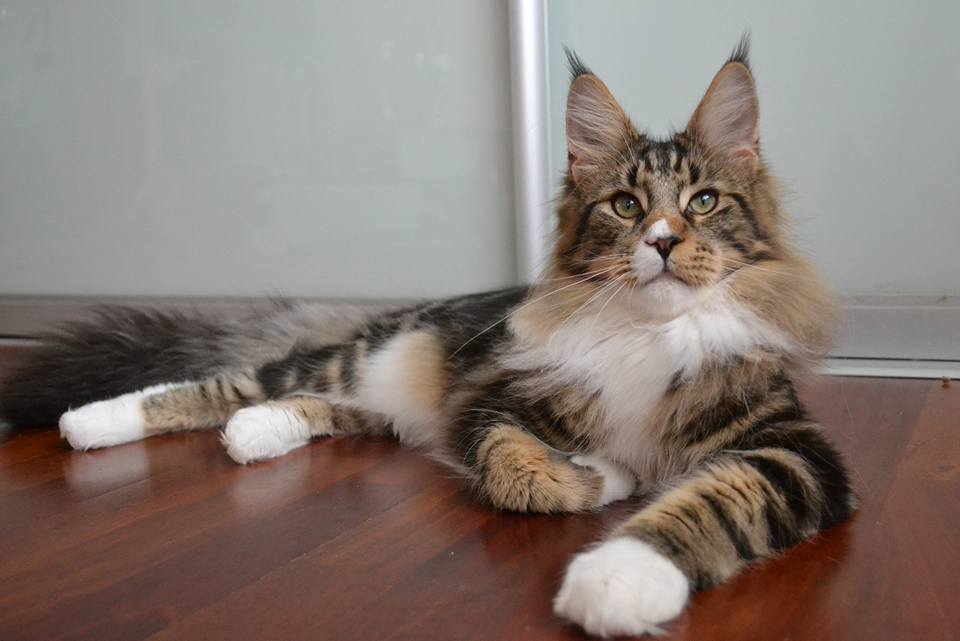
RV: The name of my cattery came into existence 10 years ago. I was searching simply something like that - glamour, miracle etc as I adore Maine Coons. GLAMOUR cats was my winner, but it was not "free" for the registration, Imagine Glamour was correct already :)

MJN: Among Siberians, color points are acceptable. I believe, they are not acceptable in Maine Coons?

RV: You are right, color points are not allowed in Maine Coon and I am happy for that. I love the "natural" colors. Btw color pointed Siberians are called Neva Masquarade and it is the sister´s breed of the Siberians :)

Tuesday, September 15, 2015

Penmore Press - a new landmark in artisan publishing

There is a new player in the arena of artisan publishing – Penmore Press based out of Arizona. The new venture was started by Michael James, a retired naval engineer whose adventures had taken him all over the world - Malaysia, Borneo, Iran and Europe. Integrating his love for quality literature and his knowledge of the ever-shifting industry, Michael approaches the publication process with a balance of enthusiasm and meticulous care. In a candid and constructive interview, he talks about the challenges and rewards of building a publishing landmark in the extremely fluid and temperamental market.
__________________________

MJN: Many publishers, when they first start out, rake up tons of manuscripts. As result, they often end up overwhelmed by the volume of legwork that needs to get done. They are so eager to churn out product to put on their website, quality often gets sacrificed for the sake of quality. How many books do you think is reasonable for a small press like yours to produce in its inaugural year and market successfully?

MJ: Truth be known when I first started in the business I took the example of my predecessor and did just that. Over time one learns that this is expensive and unproductive. Now with Penmore Press we are being much more careful. We only accept those books which we really like and feel that we can go to the effort of marketing within our means effectively. One or two books a month is our maximum with the accent on one a month. It depends upon how 'clean' a book is when we have accepted it as the process demands quality. There are slip ups when haste and volume take the place of quality.

MJN: Do you think it's better for a small press to focus on a particular genre/topic and set it a goal to truly become an authority in this field, or to differentiate its publishing portfolio and have a little bit of everything? For instance, some highly regarded genre presses like Samhain only do horror and romance. They don't take any chances with cross-genre material. They know what they can sell successfully and they stick with that.


MJ: I think that if one is careful and very selective then books of many differing genres can be accepted. We used to focus on a more or less single genre but in fact there are some exciting books out there which are looking for a home. Once again we are being very selective. However a well written manuscript will certainly get a reading and then a thoughtful decision as to whether we will run with it or not.

MJN: When you sign up with an author, do you discuss the marketing expectations on both sides? I am sure that you deal with authors in various age brackets and of varying degrees of computer and social media savvy.


MJ: We generally have an informal discussion of the breadth and width of the marketing band we can offer our authors. Today it is often hard to figure out just where a good book will do well. The big publishers can and do throw a lot of money at what they put out and regardless of how well that book is written it will do as well as the $ invested. Indies cannot do this so we need to be very careful as to where we spend our $. We make it clear to our authors that they are part and parcel of this process and have to get out there. We do our bit with reviews, prize applications, free books and encourage book signings.

MJN: Do you ever feel like the moment you learn the rules of the publishing game and finally get a grip on the situation - the rules/trends suddenly change, and you have to re-learn everything? For instance, another publisher told me the other day that blog tours are "so 2008". Less than 10 years ago they were "the" marketing method.

MJ: This is one of the most fluid markets out there. Almost as bad as the music industry where the artists seem to have the thin edge of the wedge all the time while the producers do well and the pirates flourish.

The Indie publishers fill a niche which has been born because the Agents or "Gate Keepers” for the big publishers decide who will be let through and who will not. There are a many good writers out there who would not get a hearing without the help of Indies. That said we find that we have to be constantly aware of the changing options available for them when the book actually comes out

MJN: I applaud you on your website. It's not just a submission portal - it's a destination. It looks like an attractive luxury cafe that one ventures into and just hangs out. It's also a place for your authors to meet and connect with each other. Was that your intention, to create a friendly place for authors, reviewers and readers to meet?

MJ: Very kind words. Our Web master deserves all the credit for that. An author needs to feel welcome and that this is the right place to come with their work. It is also meant to indicate that we take our authors seriously as people who are creative and to be encouraged. They are encouraged to interact with each other and that includes being on Facebook and other mediums.
 

Monday, September 14, 2015

Vincent LoCoco - an eloquent Italian American voice in Historical Musical Fiction


Greetings, commies and libbies!
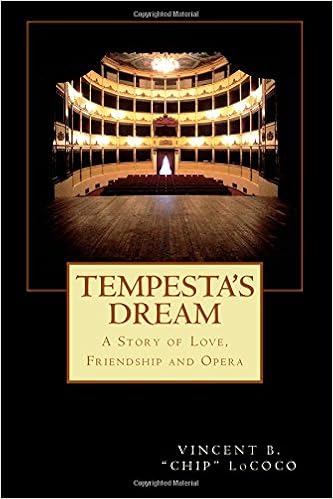
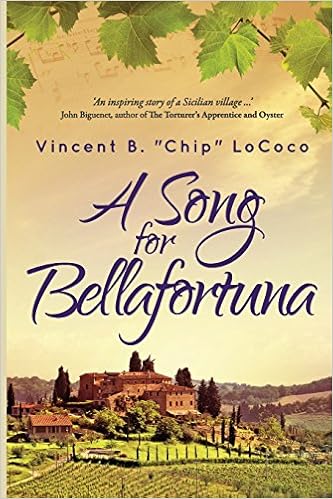
Today I am thrilled to feature an award-winning and bestselling author of historical musical fiction, Vincent LoCoco. He lives and practices law in New Orleans.  His other passions include opera and literature. No wonder he wed his two passions in his books, Tempesta’s Dream and A Song for Belafortuna.
__________________________________________
MJN: At a closer look, the subtitle of Tempesta's Dream - a story of Love, Friendship and Opera - is a little paradoxical. Coming from a family of classical musicians, anything involving opera would be modified with words like "rivalry" and "backstabbing". Perhaps, Italians are more forgiving and generous that Russians?


VL: Oh, I am sure the competitive spirit runs amuck in the opera world.  As for my novel, the subtitle refers to the characters in the opera.


Love – Giovanni Tempesta falls in love with Isabella, the girl who he has always dreamed of in his operatic worldview. He grew up on operas, and strongly believes at love at first sight.


Friendship – Alfredo, a blind retired singer at the Casa di Riposa, takes young Giovanni under his wing and teaches him how to sing opera, but more importantly, a friendship is formed that transforms both of them.


Opera – The real protagonist of the story. The story was a means by which I could pass along my adoration and passion for opera to my readers.


MJN: In the past months I have interviewed several other authors whose novels revolve around careers of musicians, including The Red Priest's Annina. Would you say that historical novels with a musical theme are their own category?


VL: I could not agree more. I am known as an Italian Historical Fiction writer, which is the closest to describe it, although not perfect. I really think I am more a Musical Historical Fiction writer. There have been so many before me, who have written about composers, conductors, singers and such. It really should be it’s own category.


MJN: You currently live in New Orleans, which has been a pilgrimage site for many authors, artists and musicians seeking inspiration.  Tell us about the effect that the city has on you. 


VL: It’s true I live in New Orleans, but more than that I was born and raised here. So I am fully confident that what I am about to say is biased. So be it. I have travelled a lot, been to many different cities, and no where, and I mean no where, do you get anything like the French Quarter. This is the Latin Quarter in Puccini’s La Boheme. A place where tourists walk over the same stones that the Pirate Jean Lafitte strolled, and came up with his plan to try to rescue Napoleon from exile. A place where ghosts feel just at real as the tourists. Many a times I take computer down to the Quarter, find an outside café, get a coffee, and transport myself to Europe and began the writing journey. It is a magical city.


MJN: Tell us a little bit about the awards that your books have won.  I'm talking about the 2014 Pinnacle Achievement Award in Historical Fiction.  When you submitted your novel for consideration, did you think that you had a high chance of winning the award?  Would it be beneficial to read novels who won in the prior years, just to get an idea of what the judges' tastes are like?


VL: I would not spend my time reading novels to see what the Judges like. I think it’s more important to make sure your novel is the best it can be, and is ready for submission. Here is an example. An early draft of my second novel, A Song for Bellafortuna, was submitted to the William Faulkner Writing Competition. It was named as a Short List Finalist. Then the novel went through a major revision with my agent in New York. It became a great book. I often wonder if I had submitted it after those revisions, would it have had a better chance of winning. My advice, leave nothing on the table. Make sure your book is ready to go.


MJN: Your novels are set in the country of your ancestors. One of my early loves was an Italian gentleman, who defied every stereotype imaginable - lethargic, blond, blue-eyed, Protestant. He hated his mother and pasta.  A living negation of every Italian stereotype! Are there any pervasive ethnic stereotypes that you hope to counter through your literature?  Or do you occasionally indulge the unenlightened masses and give them what they expect in terms of portrayal of Italians?


VL: He hated his mother and pasta. There is no such Italian man. This is a great question and one that really made me think. Of course, we all have Italian stereotypes in our minds. But the more I pondered this question, I think my answer would be that the story’s protagonist and the locale is usually set first. Then the story develops as the character develops in the story. That is the fun part of writing. When the story begins to take you places you never expected it to. I remember reading a letter J.R.R. Tolkien wrote one day when he was at work in the early stages of Lord of the Rings. He stated in that letter that he had just introduced Black Riders into the story, and he could not wait to get back to writing to discover more about them. Writing is a journey. So, at least for me, I don’t think I write from stereotypes, but instead just follow the story where it leads.


Thanks for taking the time to get to know a little bit about my writing career and me.

Sunday, September 13, 2015

March to Destruction - a Napoleonic era adventure novel by Art McGrath


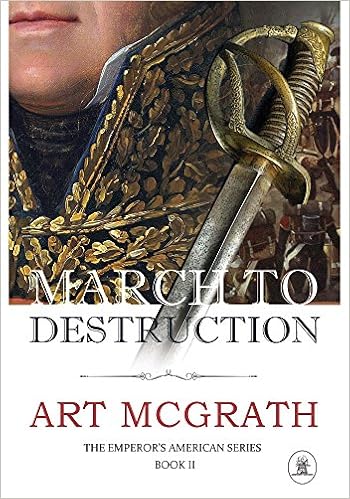
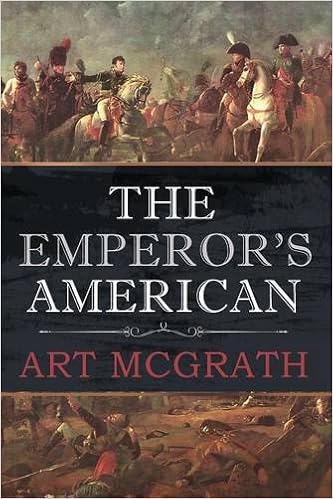
In a page-turning sequel to his debut novel Emperor’s American set during the Napoleonic era, author Art McGrath continues the adventures of his Franco-Scottish protagonist Pierre Burns. In March to Destruction Pierre fights in the Grande Armée while dodging assassins.


MJN: One reviewer likened your work to Arthur Conan Doyle's "The Adventurers of Gerard".  Was it a comment on the merit or the technique? I would be more inclined to compare your work to that of Rafael Sabatini. I believe, the sub-genre is called picaresque?

AM: Well of course I hope it was on the merit though certainly the comparison in part came about because of the subject matter. Historical fiction from the French perspective of the Napoleonic Wars is pretty rare, at least in English. I'm flattered by the comparison to Sabatini, Marina—we should all be so fortunate--though I wouldn't say it is a picaresque novel, as it only bears one or two of the seven traditional elements of a picaresque novel. I would call it military historical fiction.

If I had to name an author as a model it would be Bernard Cornwell, who is the current standard by which all Napoleonic military historical fiction is measured, at least for land combat. He has a formula, with each novel ending at a major battle. Others in the genre of military historical fiction, Goldsworthy, Gale, have taken up the formula because it works. I didn't end book 1, The Emperor's American, at a major battle because there were none in 1804 and I wanted to acclimate Pierre—and the readers—to French military life and the period. Book 2, March to Destruction, does end at a major battle and book 3 will end at Austerlitz, the greatest of Napoleon's victories. I hope to have that completed by the end of the year.

MJN: Your protagonist, Pierre Burns, is an American born to a French mother and a Scottish father.  Historically, there has always been a Franco-Celtic link, as the French and the Scottish (and especially the Irish) had suffered a common enemy - the English. Was your choice of the protagonist's heritage deliberate?


AM: Absolutely. I wanted to give him personal and familial motivation and decided that his grandfather had fought at Culloden and that he was Catholic. Culloden was in some ways the last gasp of Scots Catholicism, and the Highlanders largely remained Catholic until after Culloden in 1745, something I was unaware of until I began researching the first book in this series. I experimented with a number of Scots names and regions in Scotland where his family would be from. I also considered making him Franco-Irish but eventually settled on making him Franco-Scots, though a major supporting character is Irish. I am of French and Irish descent and didn't want it to seem semi-fantastical-autobiographic.

And of course I wanted him to be an American because that gave me a window into this world so as Burns discovers it, so do the readers. The idea started with an American joining the Grande Armée long before I decided on his ethnic background.

MJN: Pierre's arrival in Europe is purely accidental. It's a common technique used by many great authors to have a down-and-out character plunged into an adventure against his volition and then find the experience to be incredibly stimulating and invigorating. In a sense, Pierre is not totally in control over his fate, but he capitalizes on his own misfortune. Under different circumstances, do you envision your protagonist choosing this path deliberately?

AM: You are right that it is a very specific set of circumstances that led Pierre into the French Army, an option he would never have considered otherwise. I would say he is already disposed to do this and just needed the right alignment of the stars. After all just before he was stranded in Europe he was already fighting the English on what was for all intents and purposes a pirate ship.

Would he have crossed the Atlantic to join the French army? That is unlikely, though if he ran across a French soldier returning to the wars perhaps he would have accompanied him.

MJN: Having "a price on one's head" in 1805, before photography or social media, was a little different than it would be now. We have all this technology to track people down, making it harder to flee from your enemies.  What kind of clues did assassins have to rely on in 1805 to make sure they got the right person?

AM: In the case of Pierre Burns, he is not exactly an anonymous figure. He is an aide-de-camp to a marshal, which means he is in a conspicuous uniform and is well known. As an aide-de-camp he works and travels alone quite often. He is a far easier mark in some ways than if he were an infantry officer surrounded by his men. And let's just say the assassins might have help from within the French army identifying him and his movements.

MJN: Let's talk about the cover. Many historical novels with a predominantly female audience feature female models in period costumes with their heads partially cut off, leaving just the mouth and the chin visible. Historical novels with a Napoleonic setting often feature tall ships.  Were you and your cover artist deliberately trying to deviate from the tradition?
 
AM: I have to give full credit to Christine Horner for the cover. My thought was initially to go with part of a painting from a battle but she insisted that marketing research shows that partial close up shots of people and equipment draw readers in. I was skeptical until I saw the cover and was blown away. I have no idea whether it was her intention to deviate from the tradition but if it works I will not argue with success. Everyone who has commented loves it.

As for why there were no tall ships, the novel takes place hundreds of miles from the ocean. Ships would be out of place but I can see why people might think tall ships and the Napoleonic era. Fiction about the era is dominated by seagoing yarns—Patrick O'Brian, Alexander Kent, Dewey Lambdin, to name but a few. Getting away from that stereotype is one reason I wrote these novels.

A ship might have worked on the cover of the first book, The Emperor's American, since the novel opens in the middle of a sea battle but not after that. In fact artist Tal Dibner, who does many paintings of historical events and people, did draw a proposed cover for The Emperor's American which my publisher did not use but now is the cover picture on my Facebook author's page.

Thursday, September 10, 2015

Jason Vail - combining martial arts with Medieval mysteries


Jason Vail is a writer of historical fiction and a martial artist who blends rich historical detail with realistic martial action. His martial arts career includes training in karate, jujutsu, judo, boxing, wrestling and mixed martial arts. Since 2001, he has been a student of historical European martial arts and is an avid longsword and backsword/broadsword fencer. However, his primary focus has been in reviving the dagger combat techniques found in the European fighting manuals dating back to 1409 not only because of their historical interest but also because of their usefulness in modern self-defense. The result of this study is his book Medieval and Renaissance Dagger Combat, published by Paladin Press.

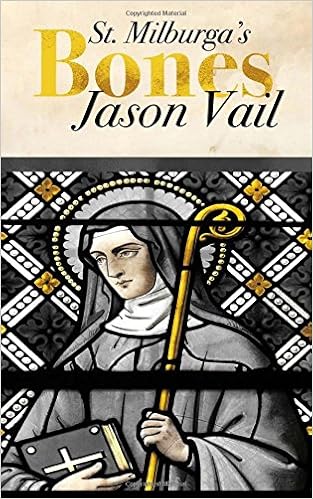
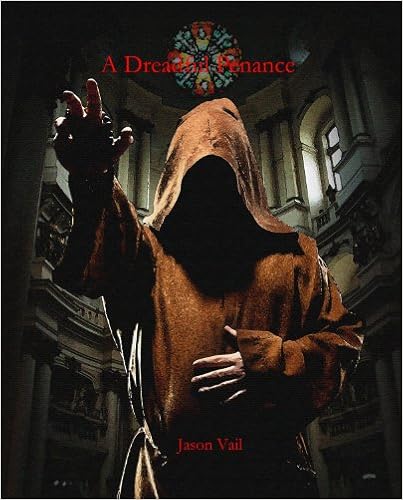
In addition to Lone Star Rising: Voyage of the Wasp, Mr. Vail is the author of the Stephen Attebrook action/mystery series set in 13th century England, whose titles include The Wayward Apprentice, Baynard's List and A Dreadful Penance.
______________________________________


MJN: Stephen Attebrook, the protagonist of your mystery series, is first presented as a broken man. I think modern audiences can make the connection, with so many injured soldiers struggling to find employment and re-enter the mainstream society. Did you have that on the back of your mind when you were shaping your main character?

JV: I really wasn't concerned about making some sort of statement about anything having to do with the present day. I came to understand Stephen through a sort of revelation, or a process of gradual discovery over a long period of time. He is a man knocked out of place by terrible events that he has not yet fully recovered from, cast down from his place in society so that in a sense he is outside that society, and he is forced to see things in a different light than he would have before. For instance, now, after his injury and his misfortune he can see himself in Harry, who has suffered far more than he has, and Stephen can sympathize with Harry in a way he could not before. Although neither of them could ever voice it, it is part of the bond between them.

MJN: You have training in martial arts which enhances the authenticity of your fight scenes. Have you ever thought of choreographic fight scenes for various historical reenactments?

JV: I don't generally get involved personally in historical reenactments. They are mainly entertainment, even where there is a martial aspect to them. I am a straight martial artist with little aptitude for entertainment. I have trained people to put on demonstrations for such enactments, however, and would do so again if asked. Mainly I just don't have the time to go all over doing that sort of thing. Also, the gear for reenactment can get really expensive!

MJN: One of the reviewers labeled your work as "historical noir" and "a looong way from your friendly Renaissance fair". It seems that gritty realism has been the standard for historical fiction. Are there still authors who make the Middle Ages look cartoonish and SUV-driving family friendly?

JV: I'm not sure if the problem with depictions of the Middle Ages by other others is a matter of cartoonishness. I tend to think people over rely on cliches about the times which often are not true. I've done a lot of research on the era, and the times were far more complex and, I think, very different than people normally think. I have tried to stay as true as I can to what is in the historical record (with a little imaginative speculation to fill in critical gaps). I wanted to create a time portal, to give people the sense of being there. (One example: on a writer's forum I used to frequent, one of the posters asked me about swords of the period, a subject with which I have some familiarity, although I do not claim to be an expert like Oakshott. She wanted her hero to have a jeweled sword. Some swords of the period of course could be very decorated, but her hero was unlikely to be rich enough to have one. Swords are just tools, after all, and you wouldn't put jewels on your hammer today any more than they did swords 600 years ago. Swords were valued not for the doo-dads on them but for their temper, their edge, and their handling qualities. She was very disappointed when I told her this, and I am sure she ignored me.)

MJN: Do you have to apply different tools when writing a medieval mystery versus a contemporary one? I imagine, in the 13th century people did not have access to the same forensic technology as they do now. On one hand, it limits your latitude with plot twists, and on another hand it opens up opportunities. Would you agree?

JV: As far as the solving of mysteries, naturally the tools available to the detectives of the 13th century are vastly different than today: no fingerprints, no video cameras, no DNA, no autopsies, no complex medicine or toxicology. Mainly Stephen and Gilbert rely on dogged persistence and common sense, and a lot of luck. So, you are quite right, Stephen and Gilbert are limited by their circumstances and use their wits. Which in turn presents some interesting story opportunities, or so I hope.

MJN: You are what they now call a hybrid author, meaning some of your books are published through a third-party traditional publishers, and some are published independently by you directly. Do you deliberately choose which books will do better with a publisher, and which will do better independently? Clearly, you have built quite a following for yourself, so you must be satisfied with your current business model.

JV: To a large degree, I have despaired of New York and the publishing industry. I've had an agent twice for different works, the first Stephen Attebrook novel, The Wayward Apprentice, and the prequel, The Outlaws. In both cases, the agents were really enthusiastic at first, but both of them sent the manuscripts out to only four or five houses and then gave up. I then tried marketing them myself without success. Finally, because I believed in the stories, I decided to take a fling and go indie with Apprentice. It was well received by readers, which is really really satisfying, so I did book 2, and so on through book 5, Saint Milburga's Bones, the latest Attebrook mystery. I also went indie with Outlaws for the same reason. I don't think I'd turn down a NY deal if one came my way, but that doesn't seem likely.