Synopsis:
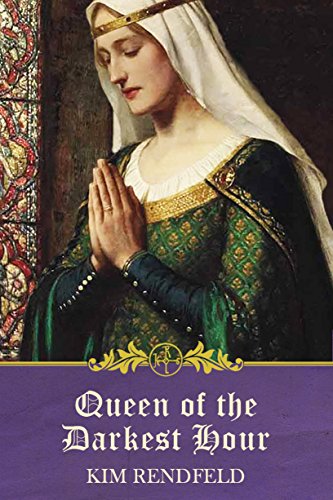
Francia, 783: As wars loom, Queen Fastrada faces a peril within the castle walls: King Charles’s eldest son, Pepin. Blaming his father for the curse that twisted his spine, Pepin rejects a prize archbishopric and plots to seize the throne. Can Fastrada stop the conspiracy before it destroys the realm?
Based on historic events during Charlemagne’s reign, "Queen of the Darkest Hour" is a story of family strife endangering an entire country—and the price to save it.
My thoughts:
Queen of the Darkest Hour is the third much anticipated (at least by me) novel in the Charlemagne era trilogy. It is in the same vein as The Cross and the Dragon and Ashes of Heaven’s Pillar. The three novels stand on their own, and the first two reference Charlemagne and his family to some extent, but this one delves deeply into his domestic life, namely his third marriage to Fastrada. The style of the narrative is consistent with the author’s prior works. You can expect the same great attention to historical detail, meticulous descriptions of clothing, rituals, dishes. The author is a self-identified feminist, so it’s not surprising that her focus is on the female figures of Carolingian history. I am grateful that Fastrada, Charlemagne’s third wife, is not “feisty”. She doesn’t fit any of the anachronistic clichés plaguing so many historical novel heroines. She doesn’t complain about feeling “stifled” by her station in life, nor does she strive to improve the lot of the underprivileged. What you have is a very balanced, pragmatic, conventional young woman of 16 who was groomed for a very specific role – to be Charles’ consort, stepmother to his brood from prior marriages and hopefully produce a few heirs of her own. She keeps her own emotions in check and puts her duty first. She has no illusions about Charles fully belonging to her. He is a mature, powerful man with "baggage". She manages to establish rapport with Charles’ existing children, including his hunchback son Pepin, who is only 2 years her junior and whose feelings are a mixture of resentment and lust. Pepin is probably the most psychologically complex and interesting character in the novel. I want to personally thank the author for not putting him on a pedestal, as many authors are tempted to do when they deal with a character suffering from some sort of deformity. In terms of plot development, if you know Carolingian history, there will be very few surprises. If you are not familiar with the story of Fastrada, do not rush off to google her. Enjoy the suspense.
Hello commies!
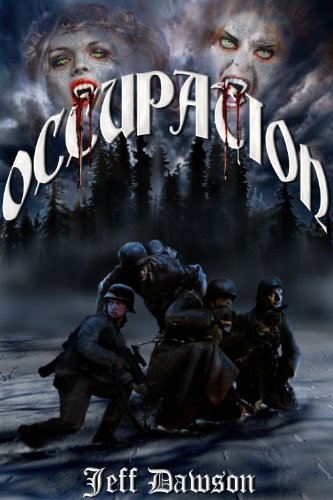
If you love WWII history and vampires, but are tired of teen drama and lip gloss, here is a treat for you. Two in one. Occupation by Jeff Dawson is a disturbing, borderline irreverent tale set in Nazi-occupied Eastern Europe.
Synopsis:
Are you ready for vampires to regain their standing in the genre? Are you ready for them to stop "sparkling" and take on a worthy opponent? Then wait no longer. This book will satisfy even the most "blood thirsty" appetites with an added twist; one of the clans is able to release a very nasty bacteria into their respective hosts which after ninety days or so unleashes a very ghoulish end to the recipients.
The Third Reich has occupied Poland!
The plan of "relocating" the population is well underway with one problem the Germans could never have imagined. Unknowingly, they are removing the food supply of the Romanov and Boirarsky vampire clans. Needless to say, they do not care for each other at all. Too much bad blood has been spilled over the past centuries. Will they be able to unite and take on the true enemy—the Third Reich, or will they perish as the food supply begins to diminish?
Get a copy today and find out if the clans succeed in uniting and dealing the Third Reich their first defeat..
My thoughts:
I was introduced to Jeff Dawson's work through a historical novel group. Being of German, Jewish, Polish and Russian extraction, I view WWII and the invasion of Poland through a unique lens. This topic is of great interest to me. I have to give Dawson kudos for exercising his very peculiar sense of humor. "Occupation" is a very dangerous mix of sacred and profane. I am surprised that this novel didn't ruffle more feathers among WWII purists. I can see someone saying that topics like the Holocaust or the occupation of Poland are off limits when it comes to creating alternative history / speculative fiction. You just don't take something as campy as vampires and inject them into a real human tragedy. And I think it is was a very gutsy move on Dawson's behalf, because he exposed himself to some pretty violent criticism. What is it called in politically correct circles? "Trivialization of human suffering." Dawson alternates very realistic, graphic scenes of nonchalant violence with scenes that border on campy. His choice of names for the vampire characters is peculiar. They are neither Russian nor Polish. He creates pseudo-Slavic, quasi-Central European sounding names. The end result is potent, multilayered kitsch.
Hello, commies and Russian history buffs!
With a budget of almost 21 million, Viking was the third most expensive Russian film. What exactly can you expect for that kind of money? More of the same old, pretty much. It better be the proverbial 100 dollar bill to be "liked by everyone".
My feelings prior to watching “Viking” were mixed to say the
least. Cautiously optimistic but mostly skeptical. A part of me rejoiced at the
prospect of seeing Russian history marketed to a global audience. At the same
time, I knew not to expect anything too authentic, too meaty, too technical or
scholarly that would alienate average viewers. Of course, the script and the
execution had to be stripped of everything too ethnic, too Slavic, to make it
more palatable for those who know very little or nothing about Russia’s
conversion to Christianity in the 10th century and the complex man
behind it. For one, the title is misleading. It prepares you for a Nordic saga.
And it is a Nordic saga to an extent, as it features certain Nordic warriors on
the Russian territory. The title is slapped on to attract those viewers who
normally would not give a Russian historical a chance. I am not going to judge
the marketing team too harshly. My biggest complaint is that there is nothing
imaginative or innovative about the cinematography. Maybe I am jaded from
seeing too many CGI effects. “Viking” combines the same proven tricks that you
expect in a superhero movie. The same washed out color scheme with occasional
splashes of blood. The hunt sequence in slow motion in the opening scene. Female
characters played by actresses with highlights and spray tan. Contrived sex
scenes showcasing girl power to placate the feminist viewers. If you are not
preoccupied with historical accuracy, if you gulp those Xerox epics on HBO, “Viking”
is another predictable, forgettable, generic Hershey kiss to shove into your
mouth.
Hello, commies!
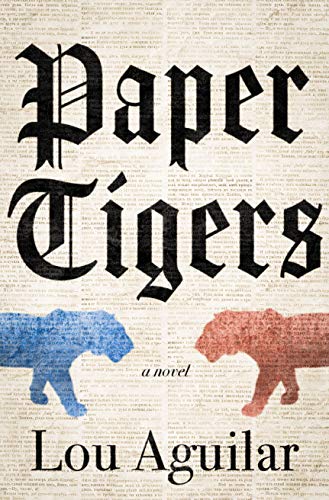
It's tempting to think that opposites attract. There are many classic love stories involving partners from the opposite sides of the barricades. Lou Aguilar's Paper Tigers is not your typical Pride & Prejudice tale. Set in post 2016 election DC, it is a story of two ambitious journalism interns trying to reconcile their libidos with their ideological differences.
Synopsis:
Two ambitious new interns at the Washington Post—a cowboy conservative and a patrician feminist beauty—match wits and sparks while vying for a reporter slot. But can chemistry trump ideology in the mad age of Donald Trump?
They came to the Washington Post from opposite sides—Nick Jarrett, the conservative son of a Wyoming rancher, and Laura London, an Ivy League feminist firebrand. They are young, bright, and attractive. Sure, they’re just copy aides, glorified gophers, relegated to delivering parcels and answering phones on different news desks. But someday, they'll be Post reporters who will save America—either from the Left or the Right…if only they can solve their "silly" romantic issues first. Chief among them are their radically opposed politics —sexual or otherwise.
My thoughts:
What does it take to make a career in journalism nowadays? The media is saturated with stories of dubious credibility, and the readership is jaded, overstimulated and polarized. There is very little place for idealism and personal expression. The young copy aides at Washington Post are up for the challenge. The author introduces us to an ensemble cast of twenty-somethings. The focus is on Nick, whose conservative views make him a bit of an oddity in the oasis of liberalism, and his colleague/love interest Laura, an entitled feminist. Laura thinks of herself as a free-thinker, but in reality all her "strong opinions" are just canned slogans. She comes with the whole bouquet of liberal beliefs: vehemently pro-abortion and self-proclaimed atheist (though on one occasion she calls herself an agnostic). We are talking about someone who champions other women's uteri and nipples yet tolerates abuse from her own boyfriend Phil, justifying his behavior. She praises the New Man archetype (metrosexual, submissive beta-male), yet she is drawn to Nick's cowboy demeanor. For a liberated woman, who is free to pick her own sexual partners, she puts too much stock into other women's approval of her relationships. Like most "empowered women", Laura is deeply insecure and conflicted underneath that veneer of girl power. The proverbial shoemaker without shoes. Personally, I found it a bit surprising that Nick, so blunt and genuine, would take serious romantic interest in Laura. Even though the author suggests otherwise, I personally see Nick's pursuit of Laura as a social experiment. He wants to see if flexing his Prince Charming muscle will break Laura's defenses. When the push comes to shove, he puts his journalism career first and makes rather bold moves to make a headline splash, knowing that it will not score him any points with Laura. It's pretty obvious that their relationship is doomed, despite the physical attraction. Opposites may attract short-term, but they don't form lifelong matches. "Paper Tigers" is an enjoyable read regardless of your own political beliefs. You will catch yourself nodding and smiling, whether you watch Fox News or CNN.
Cheers, commies!
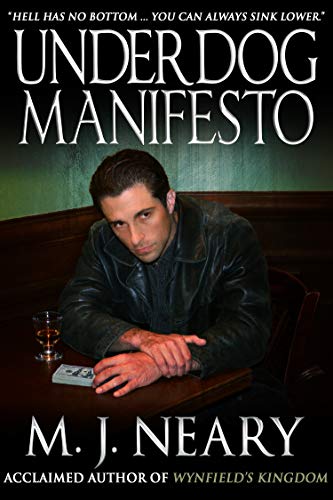
Release day! My latest literary monstrosity is here, Underdog Manifesto, via Crossroad Press. I am going to burn in hell for this one, as it contains trigger upon trigger for everyone, regardless on what side of the political barricades you're on. I thought it would be appropriate to have this novel released right before Thanksgiving. Be thankful you are not Sean McLaine. Special thanks for the talented and handsome cover model Christopher Bopp who depicted the downtrodden Boston Irish protagonist.
Synopsis
After serving time for nearly killing his student—a crime he maintains he didn't commit—Sean McLaine, a puny drama teacher finds himself broke and friendless on the streets of South Boston at the peak of the Great Recession. His joints have been destroyed by compulsive weightlifting and his mind poisoned by the subtly sadistic prison psychologist.
Salvation comes in the form of an Irish mobster who welcomes Sean into his clan and offers him a chance at a new life. A few plastic surgeries, fake documents, and a sham marriage help the underdog reinvent himself as a philanthropist. His radiant face now fronts one of the largest organ trade enterprises.
To add a finishing touch to his saintly image, he adopts a mentally ill orphan named Casey. Diagnosed with juvenile schizophrenia and believed to be a menace to society, the girl spends most of her days in isolation with no access to electronics. When the flimsy child morphs into a moderately attractive teenager and catches the eye of a film student, Sean's lukewarm paternal affection takes a sinister turn. His inner demons that had been dormant for years become more active, and the weight of his secrets becomes a bit too heavy for his shoulders.
Amidst the political upheavals and school violence of post-election America, the battle for Sean's soul begins. Very soon he discovers that hell has no bottom—you can always sink lower.
Hello, commies!
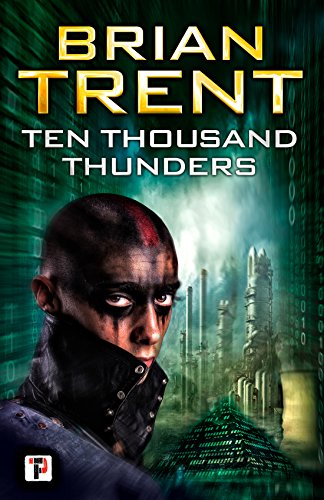
Today's gem is Brian Trent's latest sci-fi novel Ten Thousand Thunders, recently released via a new publisher Flame Tree Press. If you appreciate literary sci-fi with references to theology and mythology, this novel is for you!
Synopsis
Having just been killed in a mysterious shuttle explosion, Gethin Bryce is back to uncover what happened. An unusually gifted investigator with the InterPlanetary Council, Gethin is tasked with seeking out the truth behind unexplained anomalies that lie outside IPC control.
His investigation takes him from the luxurious enclaves of Earth’s elite, to the battered Wastelands beyond civilization’s protective thrall. Linking up with an inquiry team from a planet-spanning corporate powerhouse, he also befriends a grim and reluctant outlander who has an important piece of the puzzle—evidence of a sadistic entity which threatens not just civilization, but all life…
My thoughts
Ten Thousand Thunders is a long-awaited novel by Brian Trent, who has already created a solid following of discerning sci-fi fans. His short speculative fiction has been published in some very elite venues. I happen to know (from reading interviews with the author) that he identifies himself as a skeptic and an agnostic. It's somewhat ironic that he incorporates so much Biblical as well as pagan mythological imagery into his writing. The theme of resurrection and transfiguration permeates this fiction. The author also has very high expectations of his readers. He does not dumb down or sugar coat. He expects his readers to have a solid foundation in mythology and classic sci-fi. I saw some reviewers imply that his writing is too dense, complex and a challenge to their attention span. I am not going to argue with that assessment. This particular novel is not a "page turner" in the sense that you skip through the pages between daily tasks. You have to savor his writing in small amounts as if you would sip good red wine. Sometimes you have to pause, go back and reread certain passages. It's not a light read, but it trains and disciplines your brain to appreciate and enjoy this kind of intricate writing. The investment is well worth it.
Happy Halloween, Commies!
What would Hallow's Eve be without a chilling read? Not everyone has time for one of Stephen King's 1200 page titans. John B. Rosenman's speculative short stories are literary, thought-provoking and satisfying. This Halloween consider his psychological horror story Daniel, My Son.
Synopsis
Suppose you went out trick-or-treating with your seven-year-old son on Halloween and something terrible happened? He ran up a walk to a house and just disappeared, and you could never find him. Suppose a year later on Halloween your grief-stricken wife demands that you take the plastic, candy-filled pumpkin container which is all you could find of your only child and retrace the route you went with Danny? She tells you that unless you find him and bring him back to her, you should never return.
What would you do?
And what—if anything—will you find when you go out into the night on this mad, hopeless quest and visit the same sympathetic neighbors as the year before?
My thoughts
Daniel, My Son is an exploitation piece in some way. It exploits a very common parental fear, that of losing your child under mysterious circumstances. It is horrifying enough to lose your child to an illness or an accident, but when your child goes missing, there is no body, no autopsy report, no closure. In John B. Rosenman's story, a bereaved father delves into grief and self-loathing after his only son Daniel goes missing on Halloween. Is there any way for this family to be reunited? What deal must the father make with the dark forces to bring back his son? This is a potent story to be enjoyed on Halloween - or any other day.

.jpg/220px-Viking_(film).jpg)