Thursday, February 11, 2016

Tackling unintentional plagiarism in sci-fi - interview with John B. Rosenman

Hello, commies!
Today's guest of honor is John. B. Rosenman, a retired college instructor and an amazingly prolific author of sci-fi, fantasy and horror.  It's a pleasure to have him as my guest, because I finally got a chance to ask all those burning questions.  Such as ... How in the world do you avoid plagiarism in the world of sci-fi?  And what do you do if you accidentally "borrow" from another author's concept?
______________________________

MJN: You are a retired Norfolk State University professor. One of your accomplishments was to design and teach a course on how to write science fiction. You have written and published about 350 stories. To me that's mind-boggling. How do you keep coming up with original concepts? There are so many sci-fi authors out there and only a finite number of yet unexplored concepts. 

JBR: Good question, Marina.  Of course, coming up with original concepts is a problem in all fiction, not just science fiction.  You can unintentionally reinvent the wheel in mainstream fiction, mysteries, westerns, romance fiction, you-name-it.  The problem is more pronounced in science fiction because it’s so conceptually rich and if you recycle a saga about a distant world with gigantic creatures burrowing through the sand, it’s instantly recognizable.  Readers will shout, “Whoa, Frank Herbert already did that in Dune.  It’s a rip-off!”

So you read as much science fiction and science fantasy as you can to become as familiar as possible with what’s been done.  That experience will provide you with some radar.  However, it can’t provide complete protection because science fiction is so vast.  It’s the largest genre and in my opinion embraces all the others.  Yes, it has a finite number of yet unexplored concepts, but you can present even traditional concepts in an infinite number of ways.  You know, often you can make old wine new by putting it in a new bottle.
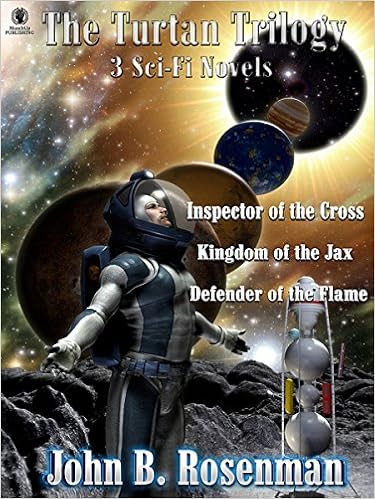
If I venture into familiar territory, I strive to make it original through the way I treat it. For example, there have been countless stories and novels that have dealt with an alien invasion from space.  Perhaps H. G. Wells’s The War of the Worlds is the best known.  Well, I’ve explored this concept in several novels.  I try to keep it fresh by giving it a unique slant in my approach and language.  In ASenseless Act of Beauty, ships from two hundred worlds invade Viridis, a beautiful African planet to colonize it just as Europeans invaded Africa.  I also present this event through multiple viewpoints, including an alien’s.  In my Inspector of the Cross series, I deliberately expanded Joe Haldeman’s prize-winning The Forever War.  Thanks to time dilation, Haldeman’s hero reaches a thousand years of age.  Talk about a long war!  Ah, but my hero is four thousand years old and counting, and unlike Private Mandella, Inspector Turtan is humanity’s best soldier and only hope. 

I used to visit a local Barnes & Noble and stroll about, letting my eyes and mind wander.  Suddenly, I’d see a book or person and BAM!, an idea would just leap into my head.  Sometimes it was sheer magic.  I once saw a book called The Calm Technique and another title, The Death Technique, sprang into my mind.  The character in my story has the ability to physically decompose, become a corpse, and then reverse the process. That is his “technique.”  Was this concept original and new enough?  I had to trust in my vision and ability when I wrote it.

MJN: Have you ever encountered a short story or a novella where you scratched your head and said, "Huh, this reminds me of something I wrote." Sci-fi writers often travel in the same circles.  So when you have so much of your material "out there", I'm sure you are wondering, "Okay, who is reading my stuff and getting ideas from it?"

JBR: This doesn’t happen to me much.  I have read stories where the Devil appears and threatens mankind.  When I do, I’ve occasionally been reminded of my dark fantasy story “The Last Snowman,” in which a young boy has to protect a snowman from Satan to save humanity.  But I thought my story was original when I wrote it and I still do.  That’s what I mean when I say you can take an old concept and make it new.  If writers couldn’t do this, fiction would stagnate. 

In the last few days, an individual has responded to an ad for one of my novels by asking if he could write a script for it.  Now there’s a twist!  I know that bits and pieces of what I read occasionally remind me of stuff I’ve written, but it doesn’t happen often.  I do hope though that my scribbles have sparked other writers’ imaginations and they are getting ideas from me—as long as they don’t plagiarize and outright steal.

MJN:  You have over 20 books with various genre presses, many of which put out predominantly e-books.  I always thought that with new advancements in publishing technology, a digital book should be a multisensory experience, with special sound effects and illustrations and animated videos.  Like a graphic novel only one notch up.

JBR: Hey, Marina, that sounds like science fiction! J  Well, actually it isn’t, and you’re absolutely right.  Enhanced eBooks include embedded media, interactivity, narration, etc., and here’s one link concerning them: http://ebookarchitects.com/learn-about-ebooks/enhanced-ebooks/

I don’t know about other folks, but my Kindle Paperwhite only accommodates static books with texts and pictures. No moving parts or animation, no voiceover.  That’s okay, though, since I only made the leap to Kindle four or five months ago.  That’s right, I had published all these eBooks, but if I wanted to read them and others, I had to do it off my computer screen. 

I have little doubt that such books will become increasingly common. The eBook revolution or evolution is here to stay, and more and more bells and whistles will be developed, especially since customers will demand them.  Where there’s a demand, they will find a way.  You know, I’ve had five audio books published, and there’s no reason they can’t evolve, too.  Just imagine what they might become when other media are added.

Here’s an idea: eventually we will not only be able to interact with these books, but enter them.  We will live in our own virtual worlds, beyond our physical bodies.

MJN: Your Turtan Trilogy is a sci-fi romance. How do you combine the two styles in equal measure?  Would you say it's more sci-fi with romantic elements, or romance set in another universe?  I know there's that category "paranormal" romance.  But I imagine, sci-fi romance is substantially different.
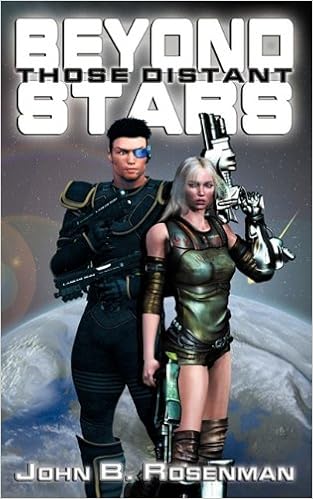
JBR: It’s more sci-fi with romantic elements.  While the romantic relationship is important, it’s not the main thing.  Some of my novels have been categorized differently.  Sci-fi Romantic Adventure is one example.  One of my novels, Dark Wizard is categorized as Paranormal Romance, but there are sci-fi elements present. They are relatively slight, though.  Sci-fi romance features science fiction more.  For instance, my novel Beyond Those Distant Stars is about a female cyborg who captains a ship from star to star.  She has a romance with a Jump Pilot whose brain is usually detached from his body so he can directly operate and control the ship.  All this presupposes an advanced science which can make such achievements possible.  Their romance is important and occurs while they are fighting the alien invaders, but it’s secondary or subordinate to the Space Opera main plot.  It’s possible to have a story or novel that is a combination of paranormal, sci-fi, fantasy, horror, comedy, YA and other elements so that classifying it is difficult.  Instead of being easily pigeonholed, it may be a hybrid of several ingredients.

MJN: You have contributed to several anthologies, as many sci-fi authors do.  Is there a science to making a successful, harmonious anthology, in which every story fits like a mosaic piece? I'm asking because I've read some fantastic anthologies, that have a very organic flow to them, tied with a loose theme.  And then there are anthologies that taste like peanut butter and chicken fingers and sliced strawberries on the same plate.

JBR: Part of it is science; part of it is feel.  It’s important to analyze and crunch numbers, but editors should realize it’s an art as well. I just had a story accepted by ROAR7, an anthology devoted to furry creatures or anthropomorphic animal figures.  We’re thinking mainly of fierce critters here, aren’t we?  Lions, tigers, and bears.  Well, my 8 K story, “A Touch of Magic,” is about a sentient Teddy bear.  Why not?  She’s furry, isn’t she?  And sometimes she looks like she’s about to roar.  The thing is, you have to decide how broadly or narrowly you’re going to define and interpret the guidelines. Sometimes a radical or unexpected submission will ignite and illuminate the collection and make you look at the subject in a new way.

As editors accept the stories or pieces, they should think about the arrangement. What goes where?  Usually the first and last selections are especially important.  Do some of the stories have a similar theme or flavor?  Perhaps they should be grouped together.  Is one story especially dark or gloomy?  Perhaps it should be followed by a cheerful or lighter one.  Your reference to “organic flow” is crucial.  A good anthology seems almost to be a living organism whose parts interact and complement each other.  Even a slight rearrangement of them would diminish the total effect.

Wednesday, February 10, 2016

Barbara Jean Coast - author(s) of Poppy Cove Mystery Series


Hello, commies!

Today I have two very special guests in one, Heather Shkuratoff and Andrea Taylor, who co-author cozy mysteries under the pen name of Barbara Jean Coast. They work in tandem, like the two characters from their Poppy Cove Mystery series.
_________________________________
 
MJN: I know it sounds crazy, but I only recently heard the term "cozy mystery". To me cozy and mystery sounds like a contradiction in terms, like "clean erotica". Tell me about the audience for that type of mystery. Does it differ from the regular mystery readership?

Heather Shkuratoff: Cozy mysteries don't have any gratuitous sex or violence. They are usually character driven and community minded, quite often in series. They tend to have a core group of main characters, and the crime solvers are often people going about their bucolic lives, have known or known of the victims and haphazardly find the clues to solve the crimes. The murders or other crimes are a big part of the story, but not the whole picture. The main crime solvers in the books are not always detectives by trade - the majority have some other passion, career or hobby that they pursue and focus on, and cozies usually describe that aspect of their lives in great detail. They sometimes find themselves in peril as they figure out what happened, but all gets resolved in the end. Cozies serve a unique function. They take readers into darker subjects but return them back to a place and time where the end often justifies the means, and all is well for most of the characters, anyway.

Andrea Taylor: The audience mainly consists of women, but there are a growing number of male readers and writers sharing their take on the genre. The readers are fiercely loyal and quite often express their love of the crime solving heroes or heroines, and really get to know the books and settings in the series. Sometimes they are regular mystery readers, but being that the cozies most likely run in series, they like to follow them in order, and are usually eager for the next story.

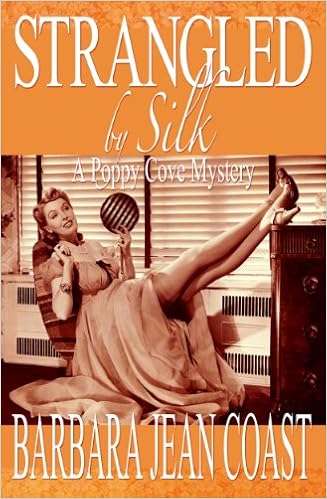
MJN: The cover for "Strangled by Silk", as well as the subsequent books, is very playful, yet there is a dark undercurrent. The title is very telling. You know there is going to be a death.

Andrea Taylor: Cozies tend to have a little black humor to them. Most of the titles reflect that sense of ironic humor, with either a play on words to be catchy and in the form of a pun, or some form of melodrama.

MJN: Your Poppy Cove series is set in California during the 1950s. It was a time of social shifts and the dawning of civil rights movement. One of your heroines is divorced - something that was far less common in the 1950s. How does the socio-political scene play into your plot development?

Heather Shkuratoff: It's actually very important in our series. The main characters Daphne and Margot, as well as secondary fellow Santa Lucians will evolve as the times change. For us it was very important to pick that time as the cusp of realization of life isn't all what it seems to be on the surface.

Andrea Taylor: Some of the stories are about the character's pasts, and some are about their futures. We have mapped out plans for our people, as the times move on.

MJN: The two recurring characters in your series are two dress shop owners. It sounds like in your series you have wed your love for mystery with love for fashion. The fashion scene has changed quite a bit in the past 60 years. Are there certain elements you would like to come back?

Heather Shkuratoff: Yes, well made clothes with great construction. There's a few manufacturers out there trying to weed their way through the mass market today, but the average garment was created with much more care then. The fit and swing of well thought out design and construction had so much more elegance than some of what we see today.

Andrea Taylor: Just no girdles, please. We can all agree to evolve past those, can't we?

MJN: If you could magically transport yourself back to 1950s and live as a single independent young woman, would you do that? I'm not talking about a Donna Reed type character, but someone like Daphne or Margot. Would you be willing to give up the technological comforts and the career opportunities of the 21st century?

Andrea Taylor: Sure, I probably would. I do use and enjoy social media, tablets and some gadgets, but sometimes I'd like to give them up and connect with people and things on a more tangible level. My main career opportunities are with writing and people, I could do them then as well as now.

Heather Shkuratoff: I would love to. They had it pretty good in the 50's, and I do feel that I could still be myself in that time. Social media, digital devices are great, but I do still love books, glossy magazines and actually talking face to face with people. I'd still want to write and sewing and designing, well, I'd be right in there like a dirty shirt.

Saturday, February 6, 2016

American Angst Punctuated by European Tapas - Unbroken - a novella by Michelle Argyle

Hello, commies!
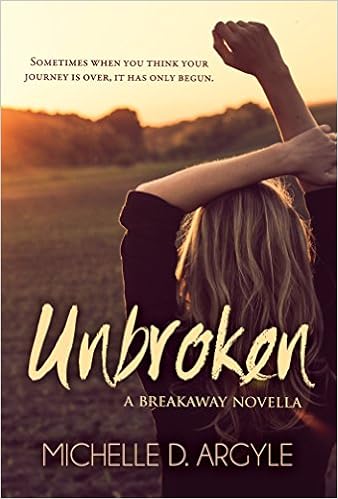
Boy, do I have a treat for you. Today I am sharing a review of a novella by an angel-faced author Michelle Argyle, whose works have stimulated some of the darkest, most unsavory aspects of my soul. Unbroken is the last installment of her Breakway series, chronicling the panic attacks of an indecisive American woman who had spent a year of her life in the company of kidnappers. 
_______________________________________
Synopsis
Fourteen years after her kidnapping, Naomi has moved on from her traumatic past. She has a new last name, a career she loves, and nobody to hold her down. When she lands her dream job managing a restaurant in Italy, she resolves not to think about what happened in that country with Jesse eleven years ago.
But Naomi’s past won’t let her go that easily.

One by one, her former kidnappers are being released from prison. When Naomi runs into Evelyn at a local market, her perfect life is turned upside down and curiosity leads her step by step back to Jesse. She’s looking for closure, but what she finds along the way changes everything, leaving her at one last crossroads with her former kidnappers.

______________________________________
My thoughts
I swallowed this novella in one gulp. I've been deriving sadistic pleasure out of the "Breakaway" series since the first installment. I am so glad I met and befriended the author, because otherwise I never, ever would've discovered her books. It's really easy for them to get lost in the shuffle with such neutral one-word individual titles and light covers that look like Midol ads.  The delightfully contrived plot and the characters you want to strangle leave you with a strange feeling of satisfaction and superiority.  Yes, this type of writing awakens the sadistic bully in me. I let out my steam by gloating over the self-imposed misfortunes of wimpy flake, and go back to the real world as a civil, marginally compassionate human being.

Naomi Jensen is back in all her whiny, indecisive, squeamish, juvenile, hand-wringing glory. In this final installment of the "Breakaway" saga there is a lot of talk about "becoming a new person".  But we all know that Naomi is the same sheltered weakling who wallows in self-pity, picks at her boo-boos and tries to gain ... uhm ... "closure".  She waddles into the fire, with her high-achieving Scandinavian goddess mommy by her side and her gang of cheerleading gang from the restaurant. There's also a great deal of talk about food.  Well, I imagine that eating any dish prepared under Naomi's supervision would give me indigestion. There's a lot of emotional baggage in every bite. This is such a biting caricature of American upper middle-class womanhood. Really makes me proud of my no-nonsense European upbringing. I eat girls like Naomi for breakfast.

Dear author, please don't stop putting out these stories about whiny American college girls. I will continue buying them and recommending them to my friends. Next installment? Naomi gets kidnapped by Syrian refugees and learns to cook Middle Eastern food in the comforts of a basement. 


Wednesday, February 3, 2016

Color of Friendship by Alireza Arteen

Greetings, commies!
I am please to introduce a gifted young author from New Jersey, Alireza Pourmanouchehri, author of a tender and lyrical short story Color of Friendship.

Synopsis
Hima is a girl who plays the violin. Armin is the boy who falls in love with her when he hears her play it. They get to know each other little by little, unaware that they are like two stars: affixed in the same sky, but still thousands of miles apart. Destiny doesn’t approve of their connection and pushes them away from each other. However, this nudge launches Armin on a fascinating journey that would rewrite what is written in his stars.

My thoughts
Alireza Pourmanouchehri's "Color of Friendship" has the bittersweet tenderness of Antoine Saint-Exupéry's "The Little Prince". The two characters, Armin and Hima, are two sensitive, emotionally susceptible teens from presumably affluent, educated and well-traveled Tehran families. The cultural peculiarities are quite apparent.  The two friends quote Western classics freely, the same way American teens would make pop culture references. Modern western teenagers do not talk to each other so formally. The reader also gets a sense that their dialogues take place out of time, like two souls talking to each other telepathically. I can see this story turned into a short film.

Monday, February 1, 2016

Nick J. Salupo - erotic fiction written by a male author!

Morning, commies!
Let's talk about gender roles in the world of erotic fiction. When a woman writes steamy scenes, she's called "bold" and "daring".  When a man does the same thing, he is called a pervert and a predator.  Dear friends, meet N.J. Salupo, formerly known as Raine Storm, author of dark, provocative, boundary-pushing fiction.
_________________________
MJN: It's fair to say that the world of erotic fiction is dominated by female authors. Do you think that as a male author you offer a different perspective and a different "edge". Or do you prefer to be regarded as gender-free?

NJS: Yes I feel that as a male author I can offer a different perspective and there's no doubt I offer a different type of edge with my style of writing. I never hold back when it comes to my novels. I do however often feel the industry is gender-biased at times. For example, I can run the same contests or write erotic novels just like the women of the industry but at times will be seen in a different light or declared a predator by hypocrites or jealous haters.

MJN: Before you were known as N.J. Salupo, you had another alias - Raine Storm. It's true that many authors write under different pen names to keep various personas separate. On Amazon you are very upfront about the switch. At what point did you decide to reinvent yourself?

NJS: I really didn't have a choice when it came to reinventing myself. Facebook forced the switch 11 days before my Tampa book signing. It was tough because a lot of people were looking for me and were not able to find me. They simply didn't know I was there but had changed pen names. As Raine Storm I had tons of followers and fans and it took some time for them to find me again once I became NJ Salupo but here I am going strong again.

MJN: According to your biography, you pride yourself in shock factor, which is something near and dear to my heart. The challenge is that readers and people in general are becoming increasingly jaded and therefore harder to shock. There are very few things that are considered taboo. I find that my own ultra-conservative posts on Facebook generate stronger reactions than messages heavily loaded with explicit sexual content.

NJS: Shock factor is so important to telling a good story and though these readers are becoming more and more intelligent and tougher to shock I still keep finding ways. Also I'm known to be one of the better cliffhanger writers out there which earned me the title, "The Destroyer of Kindles," since you'll want to throw the book at the end but still want to purchase the next one, or so I'm told.

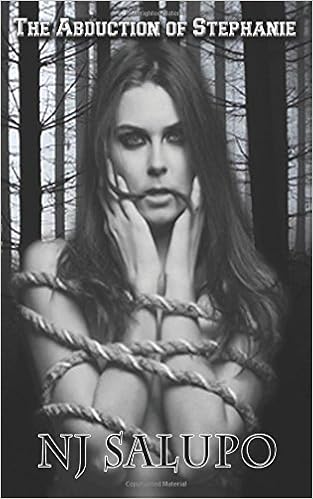
MJN: The Abduction of Stephanie almost reads like a nightmare. Did you interview any teenage girls to ask them what they feared most?

NJS: You know I didn't get a chance to interview them for that particular book which is still my favorite one I've written but I would love to do so in the future as I feel it could help with my writing of future novels. I know it's got to be tough being a teenager in this day and age and not only should we know their fears but we should pass along ways in which they can protect themselves. I have a teenager myself, though a son not a girl, I still stress to him how important it is to be careful around strangers and explain to him that evil in fact, could be staring us right in the face. It could be an aunt or uncle, a neighbor, even a teacher. Teenagers need to be careful and aware of their surroundings.

MJN: I imagine that one of your literary idols is Marquis de Sade. Just a wild guess. And your favorite film director must be Tarantino. If you were to have one of your novels converted into a screenplay, would Tarantino do it justice?

NJS: I'll be honest with you, other than what I learned of Marquis in a college philosophy course, I never thought of him as an idol of mine. Hemingway is more my literary idol. Favorite director is definitely Tarantino. I absolutely love his work. He is extremely talented and if I ever get the chance to have him direct something I've written it would be a dream come true. My goal has always been to have my books converted into movies and TV shows and it's no secret my ultimate goal is an academy award for having written a kick ass screen play.

Friday, January 22, 2016

Sarah Kennedy - Tudor England and beyond

Hello, commies!
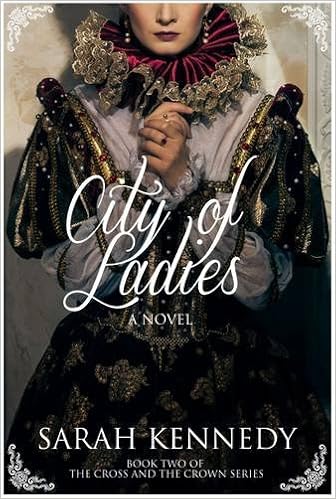
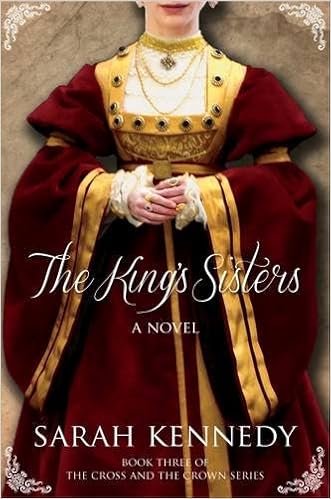
Say hello to the refined and scholarly Sarah Kennedy, the author of historical fiction set in Tudor England.
_______________________

MJN: You have a PhD in Renaissance literature.  I find that there is a lot of misconception as to what historical period that term spans. Renaissance in terms of visual arts does not always correspond with literary Renaissance. Can you shed some light?

SK: That’s a great question—because the answer is complicated.  We roughly think of the Renaissance as covering 1350-1660, but different regions had their “high Renaissance” periods at different time.  The “rebirth” of interest in and knowledge of classical art, philosophy, and literature began in Italy, but in the fifteenth century England was still in its Medieval period.  The “new” knowledge made its way north, but England doesn’t really have a Renaissance until the early-mid-sixteenth century, and it runs until the Restoration of the monarchy in 1660—when continental Europe had moved far past its Renaissance, in both the visual and the literary arts.  (England was a bit slow, I’m afraid.)  I’m not sure I’d say that England had a high Renaissance in visual art, though they did bring in painters (particularly Holbein) from the continent for the portraits that the royals and nobles loved to have made of themselves.

MJN: One of your reviewers commented on your ability to create believable, well-rounded female characters as opposed to the "flat whining court women" found in Tudor fiction. I am not going to mention any names, but I've read enough Tudor-themed fiction to know that many of those characters are indeed walking human hangers for period clothes. With so much Tudor-themed fiction out there, what special efforts do you make to ensure that your characters stand out?

SK: I’ve always had an interest in women’s history, partly because I’ve always been interested in the everyday nuts and bolts of how people in the past—the ones who didn’t have the benefit of great wealth and power—lived.  We already know a lot about the court in general, and there’s a vast amount of information and fiction about the Tudor court in particular.  I love this period in history, and I’m fascinated by the ways the Tudors managed to centralize government through the force of their personalities and propaganda machines.  But what my imagination works on is what effect this increasingly powerful court had on the relatively individualistic (and rather spunky) life of the average Englishman—or woman.  Real people interest me more than public characters, which are always manufactured for mass consumption.  I want to create women who are intelligent and strong—but who are also part of their cultures.  I want them to be good, but not perfect; to have emotions, but not idealized virtuous responses to events.  Women have noble impulses and flaws just as men do, and “ordinary” people are as complicated as the famous folks of history.  So I love my women characters, even though they have to be less than loveable sometimes to be real.

MJN: How do the professor and the storyteller in you dance in tandem when you create your fiction?  I have heard from many professors that they are afraid to write fiction for fear of it being too dry and academic.

SK: I’ve always had just the opposite problem—the academic in me always wants to tell stories!  I actually struggled quite a lot with developing that dry, academic style of writing, and it never really suited me.  I enjoy research and can spend days looking up arcane bits of information, and I love trudging around ruins and studying the remains of how people lived.  When it comes to writing, however, all of that stuff becomes not so much part of an argument but part of an imagined world.  It wasn’t really until I started writing historical poetry, and then fiction, that my academic self-found a comfortable home inside of me.

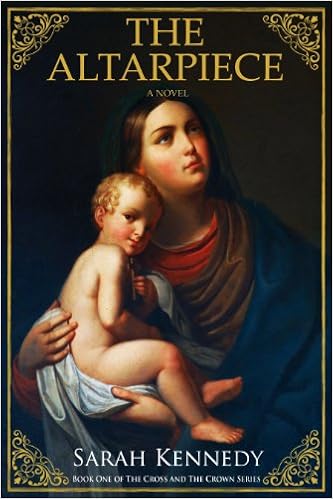
MJN: Your novel TheAltarpiece deals with the aftermath of the creation of the Church of England, putting the existing nuns and priests who had until then looked up to Rome in limbo, pun intended. Most reviews seem to be constructive, but I am sure that in real life you have gotten this reaction from your readers, "See, I told you that religion only causes bloodshed and suffering."  It seems that some single-minded individuals make that conclusion whenever they read about religious wars, that it's a blanket criticism of all religion. 

SK: I’m sure someone has thought that, though no one has ever said it to my face.  I’m not sure I’d entirely disagree, though I would have to qualify that by saying that organized religion that’s controlled by or caught up in political struggles for power often causes bloodshed and suffering—because religion is used as a justification for the bloodletting.  That’s certainly part of what happened during the Reformation and Counter-Reformation in Europe.  When two armies both think that God is on their side, you can count on some pretty horrible outcomes.  My characters see this and experience it, but they don’t just turn away from religion.  They sometimes turn away from a specific church or leader, but they don’t jettison their belief in God or the need for religious observance.  The worst of them just follow whoever is in power at the moment; the best of them try to understand and practice their religious beliefs in new ways.

MJN: As head of the English department at Mary Baldwin College, have you ever had one of your students approach you and say "I have written a historical novel"?

SK: My time as the department head ended last year, but I have certainly had students tell me that.  I teach a fiction-writing course online most semesters, so when I hear that I say, “OK, let’s see it.”  They don’t want to show it, because it’s not done, usually, so then I say, “Sign up for the course and let’s finish it!”  Teaching fiction is one of the best parts of my job, because I get those students who want to push that first novel to a complete manuscript.  We have great online workshops and go through the writing process together.  That’s a course I never want to stop teaching.  I guess teaching, reading, and writing will always go together for me.

Wednesday, January 20, 2016

1918: the Great Pandemic - interview with author (and doctor!) David Cornish

Salutations, commies!
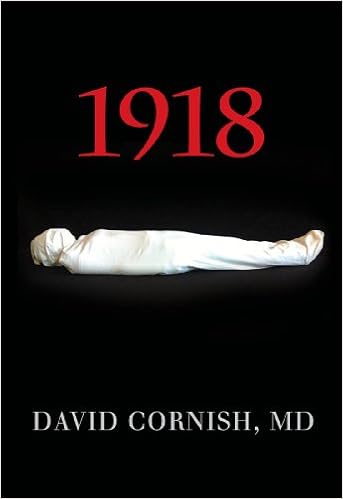
Today's guest of honor is an award-winning historical novelist David Cornish, who is also a physician by day. I came across his novel 1918: the Great Pandemic on the Readers' Favorite website (a great place to meet fellow authors) and immediately ordered a copy. I am fascinated by the early 20th century history. Shows like Downton Abbey make it tempting to romanticize that period of time. It's easy to forget that before the discovery and distribution of antibiotics, people were one bad sniffle away from death.  1918 is a chronicle of a devastating flu pandemic that claimed up to 100 million lives.
_________________

MJN: I have a few doctors in my extended family, and they will be the first ones to admit that "in our profession you have to be cynical". So I was excited to see a novel about the pandemic written by an actual doctor.  I think it's a different perspective.  "Lay" authors are at risk of making the narrative too melodramatic and sensational. 

DC: Thank you so much, Marina, for inviting me to your blog interview.  It is both a pleasure and an honor.

I wanted to write a novel about the Great Pandemic that would realistically represent the actions and thoughts of a physician in 1918.  I studied actual medical journals from the era to accurately portray the practice of medicine in the early 20th century.  I also reviewed papers from 1918 scientific journals to describe how researchers desperately sought a way to combat a disease that took 100 million lives in about 37 weeks.  My editor cautioned me that my “talk-like-a-doctor” approach in the book might not appeal to a wide audience.  I knew that was a risk.  However, this was to be a medical story about a physician, and I did not want to separate his professional language from him.  So, there are some words used that may be new to the lay reader.  Still, a number of non-medical reviewers and readers have said that the occasional “big words” did not stop them from following the story.  Rather, using the lingo of 1918 doctors has been described by readers as adding depth to the novel. 

MJN: As a man of science, can you imagine something similar happening, another deadly pandemic?  It's no secret that viruses constantly mutate, becoming drug-resistant.  And there are so many horror films and sci/fi novels featuring mysterious pandemics. 

DC: Life is a powerful force on planet Earth.  It grows and changes much faster than science has been able to react to it.  The Surgeon General in 1967, Dr. William Stewart, was erroneously quoted as saying, “It’s time to close the books on infectious diseases…”  (He actually never said that, nor believed it.)  However, some experts at the time thought mankind was on the verge of completely eliminating infectious diseases.  We now know in the 21st century the folly of that belief.  The very fact that we must come up with new influenza vaccines each year is testament to the genetic flexibility of microbes.  We are gradually losing the “war” against bacteria as one antibiotic after another is rendered less useful through mutation.  In the next few decades, humanity may find itself without any drugs that work against bacterial infections.  This is a very sobering thought.  Regarding 1918, the Great Pandemic was caused by two elements that occurred at the same time:  First, an influenza strain mutated into an extremely virulent form, as viruses sometimes do.  Second, the First World War gave the virus a way to spread quickly through human transportation on land and sea.  It is not hard to appreciate how similar elements could again create the horror of the Great Pandemic.

MJN: Your novel is close to 800 pages, placing you in the same league as Edward Rutherford, who was notorious for his mega-novels. Have you ever thought of breaking it up into shorter segments and publishing them as a trilogy?  Or did you feel it was important to preserve the length of the novel at 800 pages so it would correlate with the magnitude of the pandemic itself? 

DC: It is interesting that you mention the length of the novel, since this was another cautionary issue raised by my editor.  I suppose that a trilogy could be less imposing.  However, the second decade of the 20th century was a very imposing time in history.  The First World War was a brutal conflict that was unlike anything humanity had witnessed before.  Then, just as the war was coming to a conclusion, humanity was slammed with a virus that came out of nowhere and affected nearly every family on Earth.  I wanted a reader of the novel to feel the immensity of the era, just like people in 1918 experienced it.  The book is the length it should be, in order to tell the story as it should be told.

MJN: What's in a name? Your protagonist's name is Dr. Noble.  Charles Dickens was known for using very telling symbolism-loaded names. 

DC: A lot has been written about authors and their protagonists.  The consensus is that protagonists are either what authors themselves would like to be, or they are the mirror image of the author (i.e. the complete opposite.)  I like to think that I share at least some of the qualities of 1918’s Dr. Edward Noble.  My family is quick to mention how I do not match him in every way, but so it is with relatives!  Actually, Dr. Noble in the novel is named after a senior faculty Internal Medicine physician I knew when I was a medical resident.  Dr. Noble was the quintessential physician with great clinical skill, poise, honesty, integrity, and a bedside manner that put all his patients at ease, regardless of the diagnosis.  I admired him, and he became one of my role models.  I honor his memory by naming my novel’s protagonist after him.

MJN: Your novel has won several awards and recognitions, including Independent Publishers of New England Book Award.  Do your regular patients realize that you also have a literary life?  

DC: Some of my patients ask me If I wrote “that novel”.  I tell them, yes, and that it was great fun.  (While I was writing the book, my family began to refer to the Nobles as my “other family”.  In a way, they were.  It is interesting that after “living” with a group like the Nobles for many months, they can become very real to the author.  My guess is that many other novelists over the ages would agree.)  In any case, when patients ask me about the book, I assure them that I very much plan to keep my “day job”.

Thanks again, Marina, for the opportunity to discuss with your readers “1918: The Great Pandemic”.  I have very much enjoyed it!